

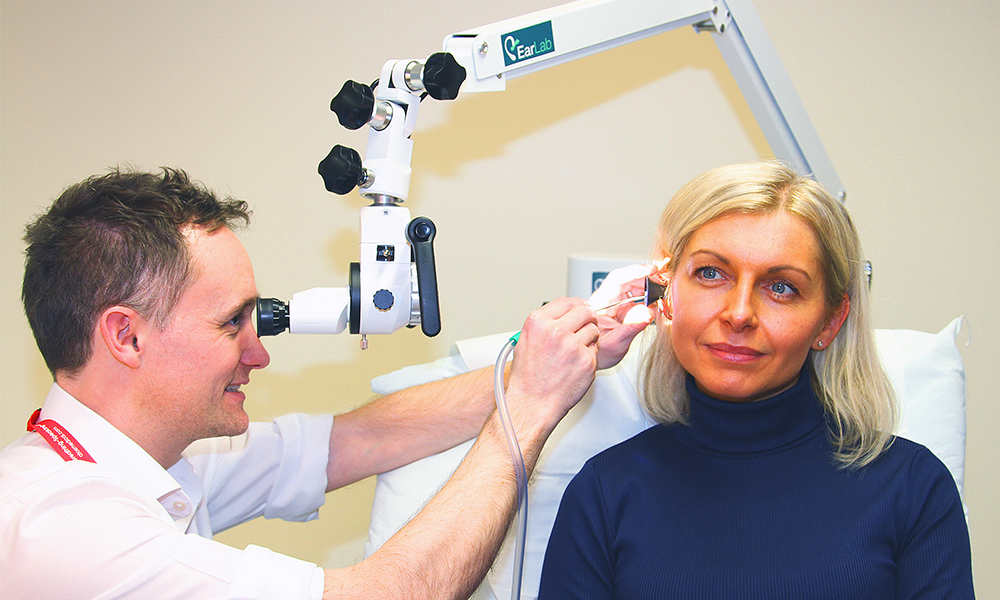
Clinics offer micro-suctioning technique, guided by a surgical microscope to ensure rapid, accurate clearing of the ear canal
Subscribe to our free Wharf Whispers newsletter here
Earwax. Right now, if you’re reading this, it’s slowly, imperceptibly flowing out of your ears.
The movement of our jaws and muscles in our faces is usually enough to create a gentle current that renews and refreshes this essential substance, whose role is to protect and sanitise our ear canals.
However, for a range of reasons, this smooth and natural process can go wrong.
Drainage fails and build-up occurs, potentially leading to hearing loss, earache, tinnitus and even vertigo.
“I was seriously ill with leukaemia and in hospital for about eight months,” said Tim Galvin, co-founder and director of EarLab.
“Sometimes I would wake up during that period and I wouldn’t be able to hear.
“When I was up, the wax would shift and I’d be able to hear again.
“I’m OK now, but one of the lasting side effects of that period is that my ears still block up quite regularly.
“While I was in hospital, a good friend of mine – David Walker – came to visit me.
“He happens to be an ear, nose and throat surgeon and he said I needed to get my ears micro-suctioned to remove the wax.
“He described the process as using a miniature vacuum cleaner to clear the ear canal.
“It’s the modern alternative to syringing – squirting warm water in there and hoping for the best – and it’s much safer.
“With the older technique, some people’s ears can be quite damaged by the pressure.
“I couldn’t get them suctioned in hospital but, when I got back home I tried to get it done locally but had to travel for the procedure.
“When I had it done, it was instant relief.
“I hadn’t realised that my ears were basically dirty, I’d just lived with it.
“Suddenly I could hear clearly.
“There was no muffling, it was just fantastic.”

the birth of a business
A couple of months later, Tim saw David again at a barbecue and the two got talking.
The NHS no longer provides syringing as a core service and GPs tend to advise using drops to tackle troublesome ear wax, but this does not work for all cases.
In some areas referral for micro-suctioning may be possible but long waiting times can be involved.
“Together, we realised there was a gap in the market,” said Tim.
“David had the medical qualifications and the expertise, but no time to handle a side business.
“I have a background in IT and experience in property, so we formed a 50-50 partnership, starting in 2022.”
EarLab operates clinics in Haslemere, Guildford, Andover and Cranleigh.
It’s now set to open a branch at Canary Wharf in facilities at Cabot Place.
“We’ve found people are happy to pay £85 for an instant service and that’s what we’ve built our business around,” said Tim.
“Hearing is really important. Without it people can feel really isolated.
“Some of our clients tell us they feel like they’ve got their lives back after the treatment.
“One elderly gentleman said he couldn’t hear conversations but, once we’d removed the wax, it turned out he didn’t need hearing aids after all.
“We have lots of wonderful stories like that.
“When you wake up in the morning and you can’t hear, it’s horrible – you don’t want to wait six months, you want to get it done as soon as possible. That’s what we offer.”
EarLab is not the only business to offer private micro-suctioning, but Tim believes the service it provides has some key benefits not found elsewhere.
“The first is that our clinicians use surgical microscopes to look inside the ears and guide the procedure,” he said.
“These give you the best possible view inside the ear canal.
“The equipment provides binocular vision at a very great magnification under a very bright light.
“It doesn’t touch your body at all and it doesn’t hurt in the slightest, but it allows the practitioner to see everything they’re doing and to have both hands free.
“We use a small funnel-like device called an ear speculum that allows us full access to the ear canal, which is curved.
“Together with the microscope, this enables us to be very precise with the suctioning and to ensure we don’t touch the ear drum, which is very delicate, and to make certain we remove all of the wax.
“With the average case, there will be some build-up of wax there, but it might not be completely blocked.”
why EarLab employs medical professionals
In addition to precision, EarLab prides itself on the level of expertise its practitioners offer, employing qualified nurses and doctors to carry out the procedure.
“We’ve grown the business organically, often expanding when we’ve found a clinician to work with,” said Tim.
“Our criteria have always been that we offer these services in an excellent medical environment with good transport links so people can access it easily.
“With David’s background and reputation, we’ll never cut corners on the service we provide.
“Having highly qualified professionals working for us means we can offer the complete procedure in 20 minutes because the people doing it are so experienced.
“We’ve expanded to Canary Wharf for two reasons.
“Firstly, I knew the area because I used to live here and also one of our existing doctors recently relocated to Lewisham and said he would love to host a clinic here.
“We prefer to grow like this and the demand is obviously there.
“When we started, we honestly thought a few hours a week would be enough, but that quickly became multiple days as word spread and people came.
“Friends tell each other and we have husbands and wives coming together to get their wax removed.
“Over the four years we’ve been going, we’ve had some people who have come 12 times during that period.
“It’s a very personal business and we have a phone line which is answered by a human being.
“Everything can be done online, but some people like to call and ask questions.
“We pride ourselves on being able to offer that reassurance.”

clearing the ears of the England rugby squad
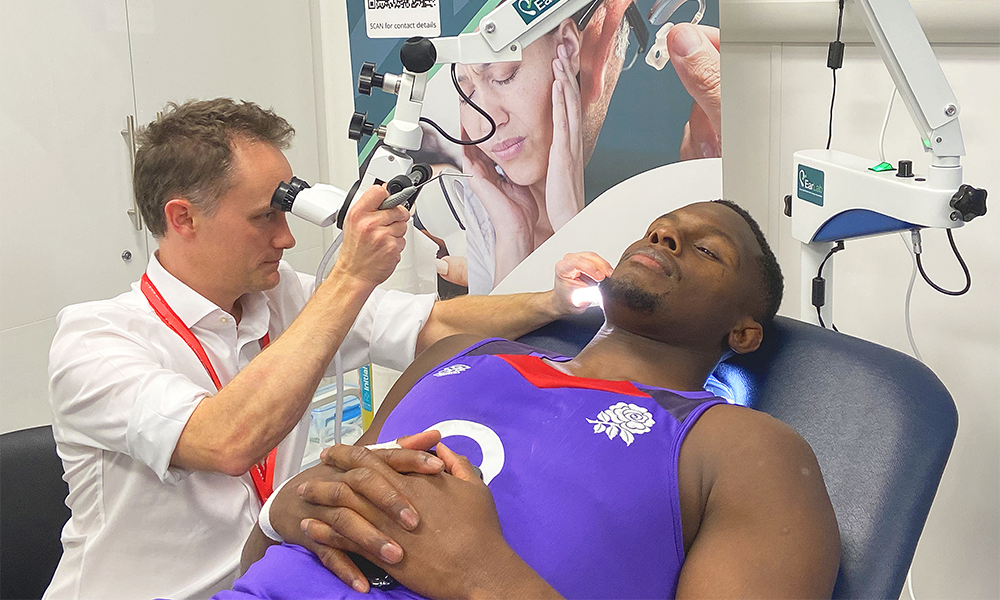
EarLab also has quite a significant claim to fame as it provides its service to the England Rugby Union squad, having been approached through the team’s full-time doctor.
“We’ve been to Twickenham three times now after David was asked to set up a temporary clinic there,” said Tim.
“The first time, we were expecting 10 players, then 20 were listed, but we ended up doing many more than that during the course of the afternoon, including the likes of Maro Itoje and Sam Underhill.
“Being able to hear clearly is an essential part of the game and they’d never had this done before.
“As a business more widely we have been surprised by the demand for our services, although there are things people do that can cause wax to build up.
“Normally, when your jaw moves during the course of a day it flexes the ear canal slightly and this creates a system where little flakes of wax are gradually expelled naturally and imperceptibly.
“That’s the natural order of things and, in a normal healthy person that’s exactly what happens.
“However, if you do anything to impede that process – using ear plugs or in-ear headphones – you interrupt that flow.
“The more you do it, the less wax can get out and the more likely you are to get a build up.
“It can get to the point where, when you’re putting the ear plug or headphone in, you’re pushing wax back down the canal towards the ear drum.
“We’ve also seen people who do a lot of swimming are prone to wax issues and others just have naturally narrow ear canals.
“Everyone is different, we’re all unique and just the shape of your anatomy can, unfortunately, cause problems for some people.
“Putting things in the ear like cotton buds is definitely not a good idea and, similarly, practices such as ear candling and using small plastic screw-like devices can be really dangerous.
“It’s so easy to cause damage with these methods because you can’t see what’s in there and you’re going in and experimenting.
“The ear is incredibly delicate and should always be treated with the utmost care by people who know what they’re doing using microscopes to guide them.
“At EarLab, we keep things simple.
“We just offer micro-suctioning and also expert advice because we can see what’s going on in the ear.
“We’re now right at the heart of Canary Wharf meaning people working or living in the area don’t need to travel to have this procedure.
“As it only takes 20 minutes, it’s easy for people to have it done in their lunch hour or even a break.
“That’s plenty of time to take the medical information we need and then to complete the treatment.”
key details: EarLab
EarLab is set to run a clinic in Canary Wharf’s Cabot Place, initially on Wednesdays, with scope to expand depending on demand.
A 20-minute treatment costs £85 and includes micro-suctioning in both ears.
Find out more about the service here
Read more: How SWR Business Direct delivers on carbon tracking for train travel
Read Wharf Life’s e-edition here
Subscribe to our free Wharf Whispers newsletter here
