

IHRE26

UCL School Of Management expands Canary Wharf presence

The university is growing its east London presence with more space at One Canada Square and new student accommodation close to the estate

UCL School Of Management is expanding its presence on the top levels of One Canada Square - image supplied by UCL
UCL School Of Management is expanding its presence on the top levels of One Canada Square – image supplied by UCL

Subscribe to our free Wharf Whispers newsletter here

University College London’s School Of Management is a good example of one of the things people often get wrong about Canary Wharf.

While today financial services companies continue to play a major part in the life of the estate, its diversification that is driving it forward.

Alongside residential towers, space for construction firms, events companies and life sciences bodies, has been created.

Towers originally conceived to house trading floors have been retooled, done up and re-leased to all kinds of different organisations.

Even 10 years ago – when UCL’s school relocated to the 38th floor of One Canada Square, just one year after its creation – things were already changing.

The mixed development at Wood Wharf had won planning permission two years earlier and the estate was preparing to become a place to live as well as work and visit. 

Having initially been attracted to the area’s status as a “major global business district”, UCL’s school has since grown into more space and developed its offering.

However, few – even today – might guess that the very highest floors of the Wharf’s landmark tower are occupied by academics and students rather than bankers. 

The university announced earlier this month that, in addition to floors it already leases in One Canada Square – 38, 48, 49 and 50 – it would also be taking on 46 and 47 too, levelling up to a total of six. 

UCL School Of Management's Professor Susan Smith - image by Jon Massey / Wharf Life
UCL School Of Management’s Professor Susan Smith – image by Jon Massey / Wharf Life

opening the spaces

“We’ll be opening up 48 this coming September and then the other two new floors the following year,” said Professor Susan Smith, a specialist in accountancy and deputy director for student experience at UCL School Of Management.

“Then we’ll have five floors all connected by a fantastic internal staircase.

“It’s really very exciting and we’re all going to get super fit.

“When we open level 47 we’ll also gain a terrace, which will act as one of our social spaces.”

When fully operational, the six floors together will accommodate the needs of some 4,000 students, all benefiting from the new facilities and spaces. 

Susan said: “We’ll be adding a new Bloomberg room, extra classroom space and informal study facilities.

“We already have signs from the Tube to help people find their way here.

“We’ve worked with our architects and have managed to get what we want, in terms of additional teaching space, which is incredibly important for us.

“There will also be places for students to hang out between classes.

“That includes more fun additions like table tennis and a café so people can buy refreshments up here as well as using the kitchen facilities to make their own.

“Of course, there are many options downstairs in the malls too.”

The school's upper floors will all be connected by an internal staircase when work is completed - image supplied by UCL
The school’s upper floors will all be connected by an internal staircase when work is completed – image supplied by UCL

expanding opportunity

Susan said being a part of the wider estate was attractive to students, given its offering.

“Being in Canary Wharf offers a huge number of opportunities, both for us and our students,” she said.

“They are part of a thriving neighbourhood that provides everything they need. 

“There are lots of things for them to do here – sports facilities and arts facilities, for example. 

“A lot of our students also use our main campus in Bloomsbury too but, with the students’ union presence here and our expansion over the next few years, we’ll have a range of activities on-site, as any other campus would do.”

UCL is an increasingly potent presence in east London with two campuses in Stratford playing a major part in the East Bank cluster.

As well as benefiting from interplay with those, the School Of Management also stands to gain from the arrival of Urbanest, a complex of three towers built beside Trafalgar Way just off the Wharf’s eastern edge. 

When they open later this year, the facility will be the largest student accommodation building in the capital with 1,672 student beds, 80 residential flats and a Drive-Thru McDonalds expected to open on its lower level in place of the restaurant that once occupied the site. 

“This new accommodation means our students will be able to live and study in close proximity,” said Susan. 

“As a university, we’ve consciously taken the decision to build around the locations we have in east London and, as we’re growing at Canary Wharf, it’s made sense to take more space in the tower too.”

The campus will be able to accommodate 4,000 students following the expansion - image supplied by UCL
The campus will be able to accommodate 4,000 students following the expansion – image supplied by UCL

shifting focus

The school offers a wide range of courses at both undergraduate and postgraduate level. In addition to degrees in such areas as Information Management In Business, Management Science and International Management, new undergrad courses for 2026 include Management For Social Change and Technology And Innovation.

“We have something to offer people whether they are starting out in their careers or looking to maybe shift the focus of what they’re doing,” said Susan. 

“Typically, the latter might be looking at our MBA programmes or more specialist areas to take a different path.

“For example, we run a course in using data to improve leadership – our MSc in People Analytics And Human-Centric Management.

“We’re always horizon scanning –  networking with the business community, other academics and thinkers in various fields – to ensure what we’re offering is relevant.

“One thing that remains constant is the foundational skill of adaptability – we want our students to be independent and critical thinkers, to be flexible, so they can thrive as the world changes.

“They will need to do that much more than we have had to as their careers will likely be very different from the ones we’ve experienced or can imagine.”

The new floors will offer students and staff more facilities including teaching spaces - image supplied by UCL
The new floors will offer students and staff more facilities including teaching spaces – image supplied by UCL

an attractive location for UCL

As one of the world’s top university’s, UCL attracts students from across the world.

“A large proportion of those studying with us in Canary Wharf are international and come from a diverse range of countries,” said Susan.

“I think they feel at home in the environment we’ve created here.

“We feel we provide an excellent student journey, but it’s not just about what happens in class.

“They have access to some amazing opportunities and a wonderful peer group, which will hopefully be with them for life. 

“They also have the chance to work with businesses on the Wharf and we are engaged in projects with a number of local companies.

“We also run a summer school with Canary Wharf Group and I’m a trustee of the University Schools Trust which supports primary and secondary education in Tower Hamlets so we have links to the community here too.

“I’m most excited about the school having a critical mass here and becoming a fully fledged campus. It will be even more of a destination for staff and students.”

key details: UCL School Of Management

You can find out more about UCL School Of Management in Canary Wharf on the university’s website, which includes a full list of courses available.

Read more: How Vintners Lanes blends wine and bowling in Greenwich

Read Wharf Life’s e-edition here

Subscribe to our free Wharf Whispers newsletter here

Subscribe To Wharf Life

UCL School Of Management seeks people to take part in studies

The university’s business school is seeking participants for experiments in its Behavioural Research Lab at Canary Wharf’s One Canada Square

Image shows UCL School Of Management Behavioural Research Lab manager Sharmay Mitchell outside One Canada Square in Canary Wharf. A woman wearing a blue and white dress with long dreadlocks swept to the left
UCL School Of Management Behavioural Research Lab manager Sharmay Mitchell

Subscribe to our free Wharf Whispers newsletter here

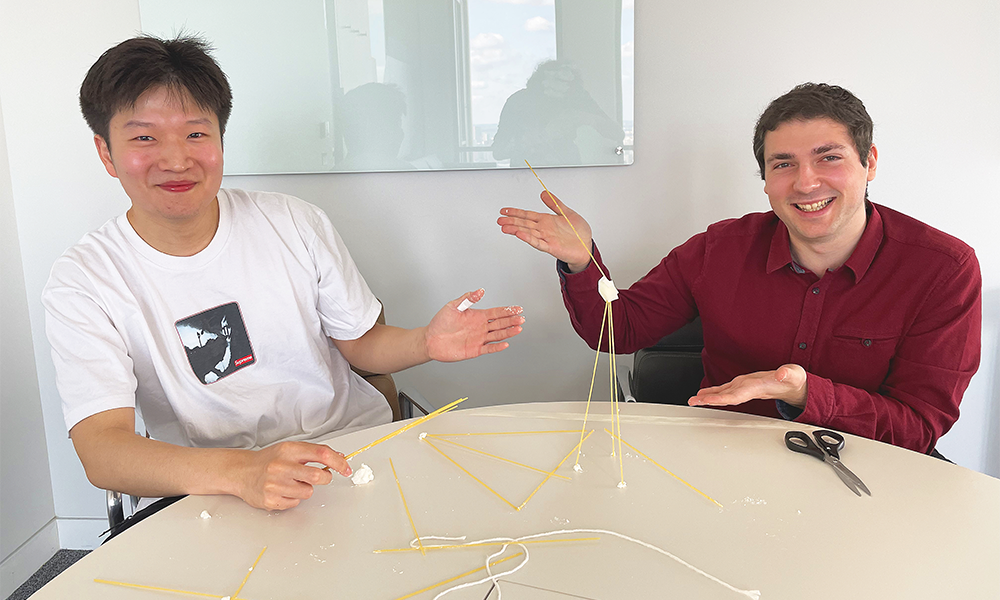
On the 38th floor of One Canada Square in Canary Wharf, two young men are attempting to build a structure.

Having only just met, they’ve been tasked with raising a marshmallow as high as possible using just dried spaghetti, string and masking tape.

They’re told their creation must stand without support for 10 seconds and be as creative as possible. They have five minutes…

It’s a sticky session.

Ignoring the tape and string at first, they tear into the marshmallow, employing it as a kind of gum to bind the lengths of pasta into flimsy tetrahedrons. 

Attempts to go higher expose the sweet’s limitations as an adhesive and, as the clock ticks down, they tape a single length of spaghetti onto the top of one tripod and place a blob of mashmallow on its end.

They’re done. 

The table is sticky with effort, but the task is complete and there are smiles all round. 

While I’m not privy to the goings-on in all corner offices on the 50 floors of One Canada Square, I’m willing to bet this is the only one that’s a venue for pasta construction.

It’s a reflection perhaps of the growing diversity of the Wharf with financial services firms increasingly sitting alongside organisations specialising in education, life sciences, technology and construction. 

What I’ve just witnessed is a session organised at UCL School Of Management’s Behavioural Research Lab.

Designed to allow the study of how and why humans do what they do in specific situations, the facility is run by Sharmay Mitchell.

Two men sit either side of a tower of dried spaghetti, marshmallow and tape they have just built as part of an experiment at UCL School Of Management's Behavioural Research Lab in Canary Wharf
Participants take part in an experiment at the lab in One Canada Square

a place for experimentation

“Once the professors have designed the studies, they come to me to recruit the participants and work out the logistics,” said the psychologist, who has more than 13 years of experience presiding over such experiments.

“Having run hundreds of studies, I think of the things other people might not.

“For example, a study might require that two participants be strangers, so you wouldn’t want them talking before the session.

“I’d also be watching to see if they were already friends and then split them up and put them with someone else, if needed.

“It’s also my job to ensure people have consented to being involved and to collect the data for the researchers, so it can be analysed. 

“We always need more participants.

“Anyone over 18 can take part, although people need a good command of English so they can interact with others and understand instructions.

“It’s something completely different for people to do – something novel.

“Many don’t know UCL is here in Canary Wharf, so it’s an opportunity for them to find out what kind of research is happening on the estate.

“It’s exciting too. You get to meet new people who may be working or studying here and most of our studies last up to an hour, so it’s something that can be done in a lunch break.

“We usually give participants £10 in cash or a gift card for studies of that length, as a thank-you for their time.”

in person or online

Studies can be in person or online with participants typically unaware of why they are being asked to complete the tasks they are given.

“Everyone gets a debrief at the end so they can understand what they were doing and why,” said Sharmay, who studied at the University Of Westminster, UCL and King’s College London, before embarking on a career in academia at the London Business School.

“It usually takes a while for the analysis and write-up to come through – sometimes a year – but once a study is published I always like to send out that information so participants can discover the findings and how their contribution to knowledge has been used.

“All of our studies are approved by UCL’s ethics committee and the data is anonymous – each participant has a unique ID number and that’s how I’ll refer to them in the data.

“At the start we usually describe studies in general terms.

“For example, we wouldn’t tell them that they’ll be using spaghetti to build a tower, just that they’d be taking part in a creative task within a group.

“I find it fascinating that some people get so dedicated to the tasks they are given – but I like that they take it seriously as well.

“Once there was a study where people were asked to build a house out of Lego, with as much time as they liked.

“One participant spent two hours doing it because they were so into it.

“When participants are being observed they definitely behave differently and, if they think they’re not being observed, they do all sorts of things.

“In the previous lab I worked at, we ran a study where participants were asked to throw a ball into a basket and tell us how many times they managed to get it in.

“They got 10p for each successful attempt.

“The ones who thought they were not being observed mostly lied about the results, although a small percentage told the truth.”

a variety of tasks

Tasks in studies vary greatly.

Sometimes participants will fill in digital surveys or may be asked to do things on their own or in groups.

People wishing to take part enter their details on a database that Sharmay uses to source participants.

“That generates a research account for them where they can log in and choose studies they are interested in,” she said.

“We also send out emails about other studies as well to recruit people. There’s no limit to the number of studies a person can participate in. It can be as many or few as they wish, but some studies will have specific criteria.

“For example, the researcher will be looking for people who are in work full-time or things like that. The more people we have signed up, the more studies we can run.”

key details: UCL School Of Management’s Behavioural Research Lab

The Behavioural Research Lab is part of UCL School Of Management, which is located on the 50th and 38th floors of One Canada Square.

Anyone over the age of 18 can sign up to participate in its experiments.

Those wishing to do so can sign up via the QR code below or are welcome to email mgmt-lab@ucl.ac.uk for more information.

UCL School Of Management offers a wide range of undergraduate, graduate and executive programmes in management, entrepreneurship, information management for business, management science and business analytics.

Find out more about participating in studies or sign up here


Image shows PhD student and teaching assistant at UCL School Of Management, Velvetina Lim, weaing a red jumper
PhD student and teaching assistant at UCL School Of Management, Velvetina Lim

case study: an experiment at UCL School Of Management

Velvetina Lim is a PhD student and teaching assistant at UCL School Of Management.

When I arrive at One Canada Square, she’s the one conducting the experiment with the spaghetti, which I witness – a task preceded by a short session where the two male participants ask each other searching questions.

“We try to do interactive tasks – where participants might do things with their hands, conduct surveys, evaluate ideas or have group discussions – and this ranges across different topics, such as social relationships or negotiating in job interview situations,” said Velvetina.

“My PhD is in social networks and creativity – exploring how connecting with each other can help us to discover the big ideas and how evaluating those ideas together strengthens social bonds.

“My hope in conducting these experiments is to see what specific aspects of an interaction we can isolate and manipulate and how that transfers onto specific outcomes, such as how much participants were talking to each other while trying to solve particular problems.

“Ideally during the experiments I’m in the room, but in the corner to make things as realistic as possible.

With these experiments, the idea is you’re isolating variables in a controlled environment.

“However, hopefully they are also simulations of situations as well – in this case emulating a product design team checking in with each other at the start of the week before engaging in project meetings.

“The first part of the experiment uses established research tasks where strangers ask intimate questions to get them to be friends and really foster a social relationship.

“Sometimes one person in the group might secretly be part of the experiment so I can manipulate what questions are asked and whether the feedback they give is positive or negative.

That allows us to investigate how those interactions relate to problem solving with the spaghetti.

“One of things I’m looking at is what happens if we label an idea ‘creative’ – how would that feed back into how the next idea is produced?

“I think this is a pertinent question about the relationship between feedback and creativity.

When we’re looking at startups or advertising agencies, for example, we often notice how such iterative interactions across time have an impact on the creative flow that creatives experience.

This helps shape the way managers and leaders feed back to them.

“I would certainly recommend people come by and participate in these sorts of tasks. 

“It’s not just one way to earn a bit of quick money, but it’s a nice thing to do on a lunchtime break.

I think that sometimes doing these tasks can help participants discover who they are or let them learn new things about themselves.

It can also help people focus on things they might ask one another when forming new friendships.” 

Read more: How Toby Kidman created a pub with soul at the Pacific Tavern

Read Wharf Life’s e-edition here

Subscribe to our free Wharf Whispers newsletter here
- Jon Massey is co-founder and editorial director of Wharf Life and writes about a wide range of subjects in Canary Wharf, Docklands and east London - contact via jon.massey@wharf-life.com
Subscribe To Wharf Life