
EX26

Dr Alessandro Ferrazza on blending business theory and practice

International Business Management programme manager at the University Of Sunderland In London explains how its approach benefits students
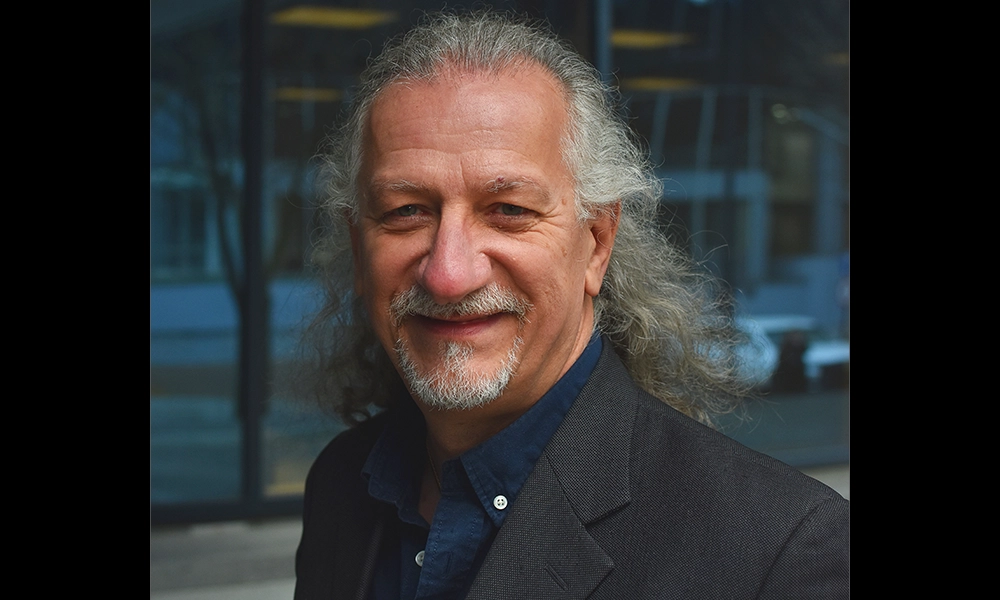
The University Of Sunderland In London's Dr Alessandro Ferrazza - image by Jon Massey / Wharf Life
The University Of Sunderland In London’s Dr Alessandro Ferrazza – image by Jon Massey / Wharf Life

Subscribe to our free Wharf Whispers newsletter here

“When I first went to university, it was all about theory,” said Dr Alessandro Ferrazza.

“Working in industry, I’d have to ask how to transfer that theory into practice. 

“The ideas sounded good in the book, but I didn’t know how to apply them in reality. What we try to do here is to break down those barriers.” 

As senior lecturer and programme manager for the MSc International Business Management (IBM) course at the University Of Sunderland In London, Alessandro is perhaps perfectly placed to take on that task.

A long career in industry – interwoven with a consistent thread of study and personal development – preceded his move into academia, after he enjoyed guest lecturing at the University Of Sunderland In London, following completion of an MBA in business administration, management and operations there in 2017. 

Going full-time in 2019, initially as an associate lecturer, Alessandro completed his doctorate in business and remains passionate – alongside the wider team – about continuing to develop the university’s IBM offering.

And, frankly, who better to teach international business?

Born in Switzerland, Alessandro grew up in Rome, completing a diploma from the Institute For Hospitality Management in the Italian capital.  
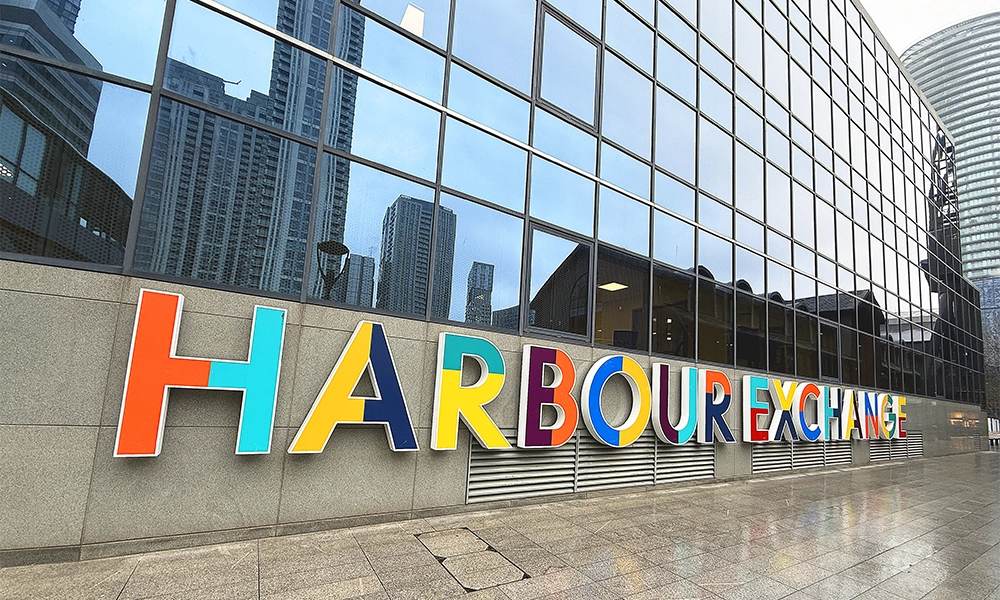
The University Of Sunderland In London is based at Harbour Exchange on the Isle Of Dogs - image by Jon Massey / Wharf Life
The University Of Sunderland In London is based at Harbour Exchange on the Isle Of Dogs – image by Jon Massey / Wharf Life

starting out in hospitality

“I started off washing dishes in Guernsey and I hated every single minute of it,” he said.

“After one week, I packed it in and walked out. They didn’t even pay me. 

“My lecturer in hospitality had told me I needed to speak English, so I’d moved to the Channel Islands and, after I’d quit my first job, I walked into the hotel next door.

“I hardly spoke any English – I couldn’t even read the name of the place – but I said I wanted to see the manager.

“It might have been luck, but this Italian guy came out.

“We got chatting and he agreed to take me on.

“My first job was to take the dirty dishes to the kitchen, so already it was a step up.

“My career took off from there.”

Moving to mainland UK a couple of years later, Alessandro built his career in hotels in London and rediscovered education.

He said: “I met someone really clever, the then manager of the Cavendish Hotel, and he suggested I should go to university. 

“That sounded really good and, in those days it was free, so I signed up at the Ealing College Of Higher Education, which is now West London University.

“On the first day, I sat down in the lecture room on the first floor with my pad and pen out. The lecturer came in and said: ‘Good Morning’.

“After that, I couldn’t understand anything else, so I left. 

“But then I took elocution lessons for a year and a half, went back and completed my degree – I was very proud of that. 

“One of the things the Cavendish’s manager did was put in my head the idea of personal development.

“It’s something I tell my students. Annual reviews are really bizarre things in business.

“Your boss sits you down once a year and points out where you’re going wrong.

“But what I tell my students is they should go to those meetings armed with what they want. It should be a two-way conversation. 

“Do you have all the training and tools to achieve what they want you to do?

“If the answer is yes and there are issues, perhaps the role isn’t right for you. 

“But, if the answer is no, then you must ask for what you need to bring your work up to the level the firm expects.”

The university offers wide range of courses, including an MSc in International Business Management - image by Jon Massey / Wharf Life
The university offers wide range of courses, including an MSc in International Business Management – image by Jon Massey / Wharf Life

connecting with the University Of Sunderland In London

Having spent many years working in the hospitality sector in London, Switzerland, Italy and France, Alessandro joined catering giant Compass Group in 2001, initially as a general manager before rising through the ranks to become regional account director. 

There, with contracts across England, Italy and Switzerland through his contacts, he had responsibility for more than 500 employees, with the company also sponsoring him to pursue first an MSc in strategic management and leadership and then the MBA that led him to the University Of Sunderland In London.

Today, Alessandro continues to use his links to industry to enrich his students’ experience by inviting senior contacts including CEOs of top companies to participate in their programmes.

“It gives them hands-on knowledge,” he said.

“They get to understand what it’s really like to be in an international managerial setting, running operations remotely across the world.

“Anyone can read a book, the one thing you cannot buy is experience.

“What we try to do with our IBM programme is to create something tangible our students can bring with them to their careers.

“Things have changed. When I first went to university, the Government paid for the course via a grant.

“Now our students are customers – we need to include the element of added value, to ask ourselves what makes our programme different?

“Theory is important, but our IBM course has more of the feel of a hands-on apprenticeship.

“For example, we run a game simulation where students become the board of directors for a company. 

“They need to make all the decisions, and those choices then determine how the organisation they’re running progresses. 

“The questions for me are: ‘How do I make the books come to life? How can real businesses reflect and use what’s in the books?’. 

“There needs to be a real synergy between what’s written in the books and what happens in industry.

“For example, over the years I’ve invited CEOs to come in as associate lecturers, to set the students a problem and then have them report back.

“In the latest one, they’ve been given an issue that a person is actually trying to fix in their business and, in March, he’s going to come back with the head of the global company and listen to their proposals.

“You can’t get any closer to being in the boardroom than that.”

staying relevant

With the business landscape constantly changing and evolving, the University Of Sunderland In London believes such links to real organisations are essential in maintaining the relevance of its courses, with Alessandro also stressing the importance of developing, honing and implementing essential skills.

“One of the reasons I made the move into education is that I want to help shape the managers of the future,” he said.

“When I was in industry, I’d sometimes recruit managers who looked really good on paper, but who turned out not to be very effective on the ground.

“That wasn’t because of an inability to understand business concepts, it was because of an inability to put the theory into practice.

“That’s what I wanted to change. I’d seen lots of people who’d achieved qualifications and wanted more senior roles as a result but then failed.

“Often they didn’t understand how to deal with people. In senior management you are really only managing two things.

“The first is resources. The second is people. If you can’t deal with colleagues, then you’ve had it.

“You’ve got to make sure your team follows your leadership, your strengths, or they won’t do what you want them to do. In the end, the company will recognise that and you’ll be out of a job.

“This is why we run group exercises and encourage collaboration to equip them with those experiences.

“I’m not saying it will be easy for students embarking on our courses. It can’t be, they won’t be spoon-fed. 

“But I do want to make sure I give them all the tools possible from the toolbox I’ve built up over my years in industry so that the next generation of management coming out of programmes like our MSc in IBM is going to be well equipped for whatever industry they choose to make their career in or whatever else they do in the future.”  

key details: Business

The University Of Sunderland In London offers a wide range of business-focussed courses at undergraduate and postgraduate level. 

Its MSc in International Business Management is a full-time course over one year, based at UOSiL’s Isle Of Dogs campus.

You can find out more about business courses at the university here

Read more: Discover Georgian food and wine at Sad Meli in Royal Docks

Read Wharf Life’s e-edition here

Subscribe to our free Wharf Whispers newsletter here

Subscribe To Wharf Life

University Of Sunderland In London opens £10million campus

Institution launches Isle Of Dogs facility, building on 13 years of success in the Canary Wharf area

University Of Sunderland in London pro vice-chancellor for international office and branch campuses, Alan Hardie - image by Jon Massey
University Of Sunderland in London pro vice-chancellor for international office and branch campuses, Alan Hardie – image by Jon Massey

Subscribe to our free Wharf Whispers newsletter here
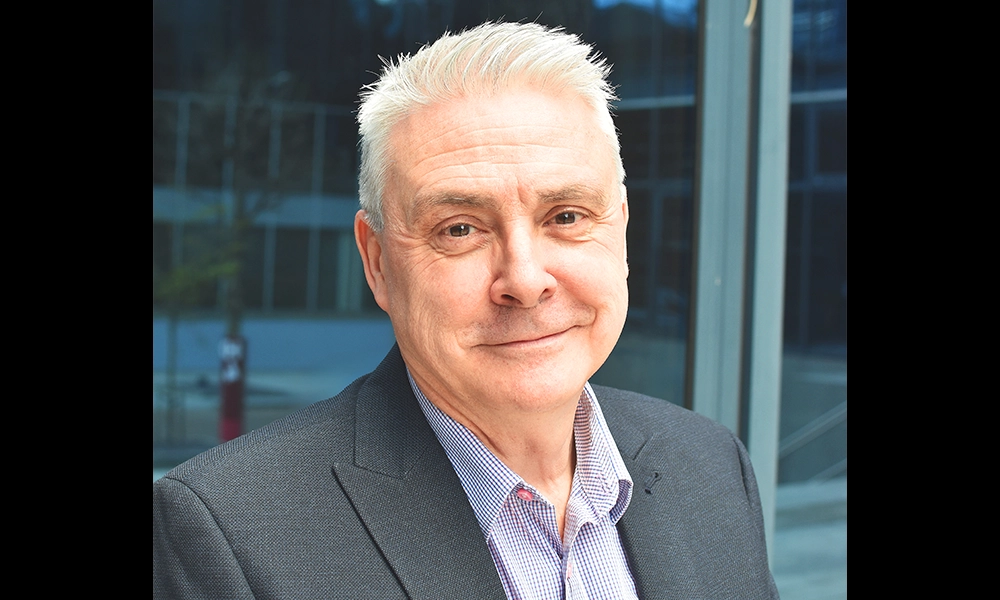
Alan Hardie is, at least in part, powered by Irn-Bru.

The Glaswegian beverage famously “made in Scotland from girders” is an on-brand drink of choice for the man in charge of the University Of Sunderland In London for two reasons.  

Firstly, the orange liquid fits neatly with the institution’s colour scheme.

Secondly, the ammonium ferric citrate that gives it its bright and fizzy hue recalls the steel necessary to make a success of launching a London campus – steel is an alloy rich in strength and flexibility.

And what a triumph the University Of Sunderland’s campus in the capital has been.

Since its launch in 2012 at a building on Marsh Wall on the Isle Of Dogs, the campus has seen more than 28,000 students pass through its doors.

The University Of Sunderland In London started off with four programmes, expanding over the years to 31.

It currently has around 6,000 students with an expectation to “grow significantly”.

That forecast has led to an expansion, with a £10million investment in new space at Harbour Exchange – a facility that was officially opened on March 27.

The new campus is located at Harbour Exchange – image by Jon Massey

a new campus

“We needed to move because our existing building was tired and it was time for a change,” said Alan, who is the university’s pro vice-chancellor for international office and branch campuses.

“The other thing was there just wasn’t the space for some courses and there was nothing else we could do to improve it.

“Those were the things driving us to do something better.

“We chose this location because it’s a great part of London with fantastic transport links and we already had thousands of students coming here – we didn’t want to say to them that we were making life more awkward by relocating somewhere else.

“I’m amazed at the facilities we’re now able to offer.

“I was able to take one of my deputy directors – Lynsey Bendon – away from her student role temporarily and the job she and the team have done on the new campus is outstanding.

“When I first saw it finished, I was genuinely blown away – we couldn’t be happier. It’s light, it’s funky and everything’s been done to a high standard.

“There are lots of areas for students to work together and on their own and a great staff area too.

“Hopefully it projects confidence, that we’re serious about what we’re doing.

“We’ve got the space to be even more successful – to prove ourselves – and I think we can.”

Based on the last 13 years, that’s an aim that seems eminently achievable, given the progress already made.

For Alan, the London campus’ growth has been a story of adaptability – being able to rapidly change course.

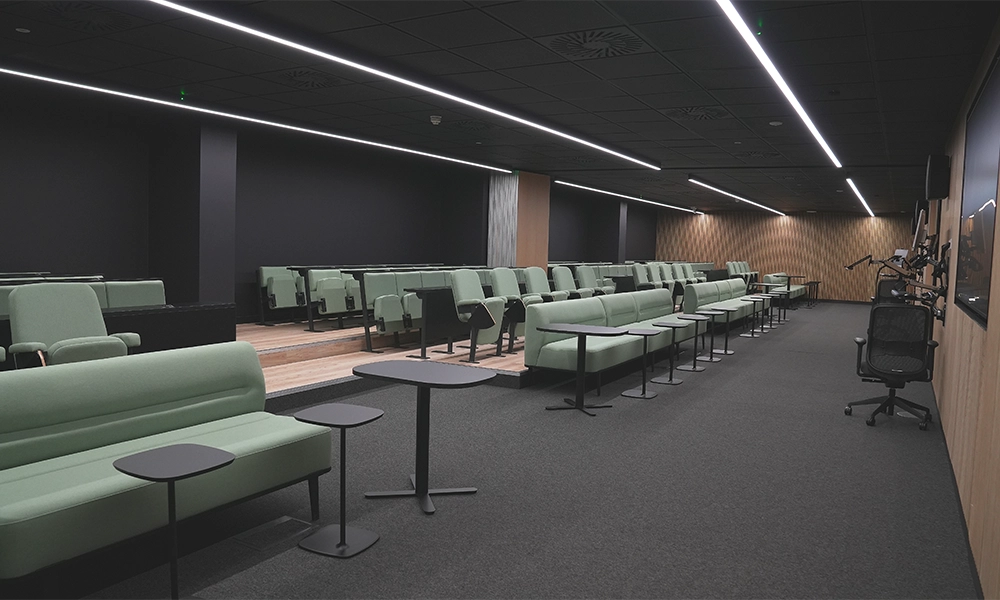
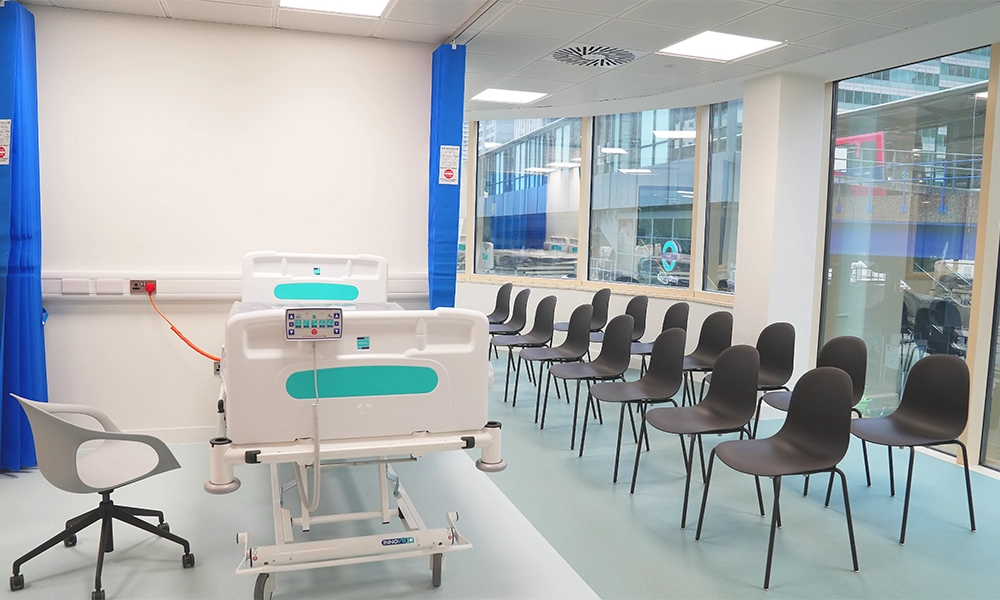
There are dedicated facilities for specific courses - image by University Of Sunderland In London
There are dedicated facilities for specific courses – image by University Of Sunderland In London

adaptability at the University Of Sunderland In London

”Here we always want the student to be at the heart of any decisions we make,” said Alan, who is originally from Newcastle and has a private sector background working in human resources. 

“If that means paying for extra staff to make things more efficient, then that’s what has to happen. 

“As we’re a smaller part of the overall organisation, we’ve managed to speed things up that would otherwise have to go through a committee for approval.

“What we’ve been fairly good at is taking time to understand our student demographic, which is different from some other universities.

“If people come through the door we should treat them really well and, in general, I think we do that.

“If you go into a supermarket, for example, they say they’re doing things for the customer, but the way the store is laid out is really in the company’s interests.

“We choose to operate the campus in a way that works for our students, many of whom are older and may be fitting their education round jobs and childcare.

“It’s important they don’t feel bounced around and that we run as a one-stop-shop.

“Over the 13 years, it’s been key that we’ve learned how to do things ourselves and change where necessary.

“We have a variable intake model, meaning we welcome new groups of students three times a year.

“We have people coming into the campus and leaving all the time with students at all stages of our courses.

“What that allows is for us to identify what is and isn’t working within a 12-week window three times a year, rather than waiting to assess things at the end of a full 12 months.

There are dedicated facilities for specific courses - image by University Of Sunderland In London
There are dedicated facilities for specific courses – image by University Of Sunderland In London

“It means we can quickly adapt and iron out any problems if necessary ready for the next intake. 

“That’s been incredibly rewarding as a process and it’s relied on having a team of like-minded people.

“We’re 252 miles from the mothership and while the original idea was that the campus would run with a small group of staff with services provided remotely from afar, it became clear after a few weeks that wasn’t going to work.

“So we learned how to be more self sufficient and that’s been a theme during our time in the capital.

“We want to celebrate our students.

“We switched to using Southwark Cathedral for our graduation ceremonies, which is an iconic venue.

“Previously we used local hotels, but moving things takes us to another level, which is what we’re always trying to do.

“The question for us is always: ‘Why should students come here?’. It’s up to us to create the answers.

“We’re not for everybody. Some institutions have better programmes or a greater legacy – it’s our choice whether we want to challenge that by doing things differently.

“Initially when we opened with just 199 students there was a kind of modesty – a lack of confidence – for the first couple of years.

“But with support from our base up in Sunderland we’ve continued to grow and expand.”

With such stellar facilities now on tap, the university is clearly on a sure foundation to build on that even further.


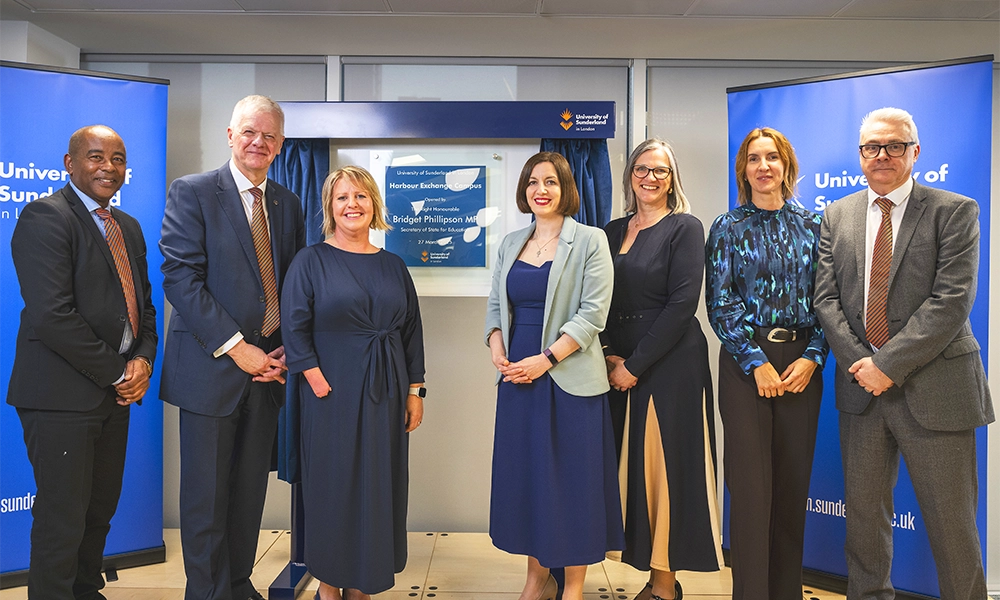
Secretary of state for education, Bridget Philipson MP, opens the new campus in the presence of University Of Sunderland chancellor Leanne Cahill, vice-chancellor Sir David Bell, Alan, deputy directors of the University Of Sunderland In London, Lynsey Bendon and Geoff Paul and head of marketing, recruitment and admissions, Jelena Miljanic - image by University Of Sunderland In London
Secretary of state for education, Bridget Philipson MP, opens the new campus in the presence of University Of Sunderland chancellor Leanne Cahill, vice-chancellor Sir David Bell, Alan, deputy directors of the University Of Sunderland In London, Lynsey Bendon and Geoff Paul and head of marketing, recruitment and admissions, Jelena Miljanic – image by University Of Sunderland In London

opening the university’s new campus

>> The University Of Sunderland In London’s new campus was officially opened on March 27, 2025, by secretary of state for education, Bridget Philipson MP.

She said: “As a Sunderland MP, it does give me such pride to see the university going from strength to strength.

“The investment here is the stepping stone to even more  growth, excellence and opportunities for people to study. 

“I know the impact the university has for local economies, for driving growth both in the north of England and in London.

“It’s more important than ever that our universities are financially sustainable and that means stepping up, as Sunderland has, to drive forward growth, opportunities and productivity – that dynamism that the sector can bring.

“I think we all know we have to do more to narrow those gaps where it comes to inequality and educational opportunity.

“The University Of Sunderland has always been at the forefront of driving that forward and I’ve seen that impact, not just for young people, but for all the adults who have had the chance to go back into education and get on and everything that means for them and their families as well.

“That’s what the university is doing with this new building and I’m so excited to see it put to such good use.

“We can all feel what that means in terms of possibilities for those who come to study here from overseas and also from local communities.” 

The new campus boasts a multitude of breakout areas - image by University Of Sunderland In London
The new campus boasts a multitude of breakout areas – image by University Of Sunderland In London

key details: University Of Sunderland In London

The University Of Sunderland In London is based at Harbour Exchange on the Isle Of Dogs and offers courses in business, finance, management, tourism, hospitality, events, engineering, project management, nursing and health as well as postgraduate research.

Find out more about what the institution offers here

Read more: How Orbit Clipper is set to become the first all-electric ferry on the Thames

Read Wharf Life’s e-edition here

Subscribe to our free Wharf Whispers newsletter here

Subscribe To Wharf Life

University Of Sunderland grants Jonathan Ganesh honorary degree

Docklands Victims Association co-founder and president recognised for his supportive works

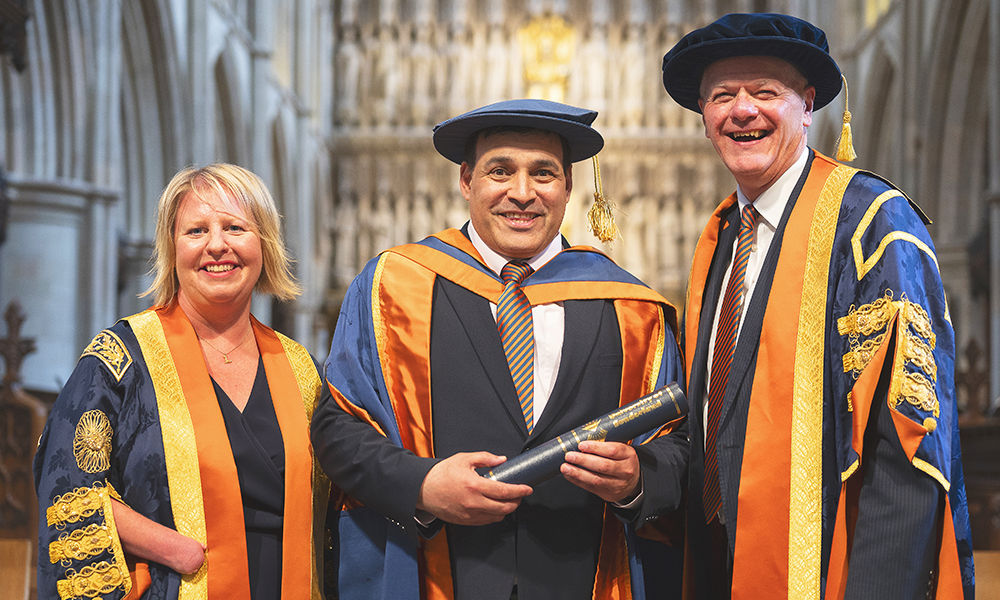
Images shows a man, Jonathan Ganesh, flanked by a woman and another man all in academic gowns, smiling at the camera
Jonathan Ganesh, centre, is presented with an honorary fellowship by University Of Sunderland chancellor, Leanne Cahill and vice-chancellor David Bell

Subscribe to our free Wharf Whispers newsletter here
It was Friday, February 9, 1996.

In Germany, a group of physicists had just managed to create a single atom of the superheavy element Copernicum for the very first time.

They’d fired zinc particles at a piece of lead in a particle accelerator to synthesise the substance, which lasted just 0.24 milliseconds before its radioactive decay. 

With an international team, the breakthrough was a triumph of collaboration and cooperation – an expression of the extraordinary things humans can achieve when working together for the good of the species.

Image shows members of the crowd clapping at the university's graduation ceremony
The ceremony took place at Southwark Cathedral

a tragedy in Docklands

But that same day is remembered in east London, throughout the UK and beyond for a very different reason.

At just after 7pm, the IRA detonated a massive bomb on the Isle Of Dogs at South Quay, killing two people, injuring more than 100 and causing £150million of damage.  

For Jonathan Ganesh, a law student and promising boxer, who was working as a security guard in the area at the time, it changed everything.

But despite suffering life-altering injuries and the challenges of recovery, the east London resident has been determined to forge something positive from his horrific experience.

As co-founder and honorary president of the Docklands Victims Association (DVA) he’s been a tireless champion for those affected by that atrocity.

He’s also been heavily involved in offering support to and standing in solidarity with all those affected by acts of terror around the world.

Constantly looking to help those around him, more recently he accepted a Pandemic Response Medal for his work as an NHS responder, delivering food and medication to local residents.

On Wednesday, June 12, the University Of Sunderland In London, which is based at South Quay, awarded Jonathan an honorary fellowship at its graduation ceremony in Southwark Cathedral – recognising his work alongside the achievements of hundreds of students collecting their degrees. 

A University Of Sunderland In London student in a mortar board and gown celebrates receiving her degree
The University Of Sunderland In London also awarded hundreds of students degrees at the event

praise from the University Of Sunderland

Vice chancellor of the University Of Sunderland, Sir David Bell, said: “We are delighted to honour Jonathan in this way and this is truly an inspirational moment for us as an organisation.

“We know, for people who become victims, it’s hard to rebuild their lives.

“But Jonathan is the most wonderful example of someone who has not only done that, but has actually helped to support literally thousands of people to rebuild their lives through the work he has done, not only in this country but around the world.

“I hope our graduates will follow his example and do things that will make the world a better place.” 

South Quay has gone on to great prosperity with office blocks and some of the tallest residential towers in London rising on the strip of land directly opposite Canary Wharf.

Apt then, that one of the organisations now based there is making this award.

University Of Sunderland In London students celebrate by throwing their mortar boards in the air at Southwark Cathedral
Students celebrate receiving their degrees at the event

a fitting tribute

“I’m quite overwhelmed, actually,” said Jonathan after the ceremony.

“This award from the University Of Sunderland In London is a fitting tribute to all of the victims – especially Inam Bashir and John Jeffries, who lost their lives.

“This is recognition for me but also for the DVA and the work we do in Tower Hamlets and globally.

“This has been a day I’ll never forget. I’m happy to receive any awards, but this is something special. 

“We plan to do a lot more work and help as many people as we can here and around the world.

“We successfully managed to secure a pension for the IRA’s victims from the Government as it was unfair to leave these people with no financial support when those from other countries such as America were receiving money.

“It’s very touching for the university to recognise us locally and that what we do has global reach extending out from here.”

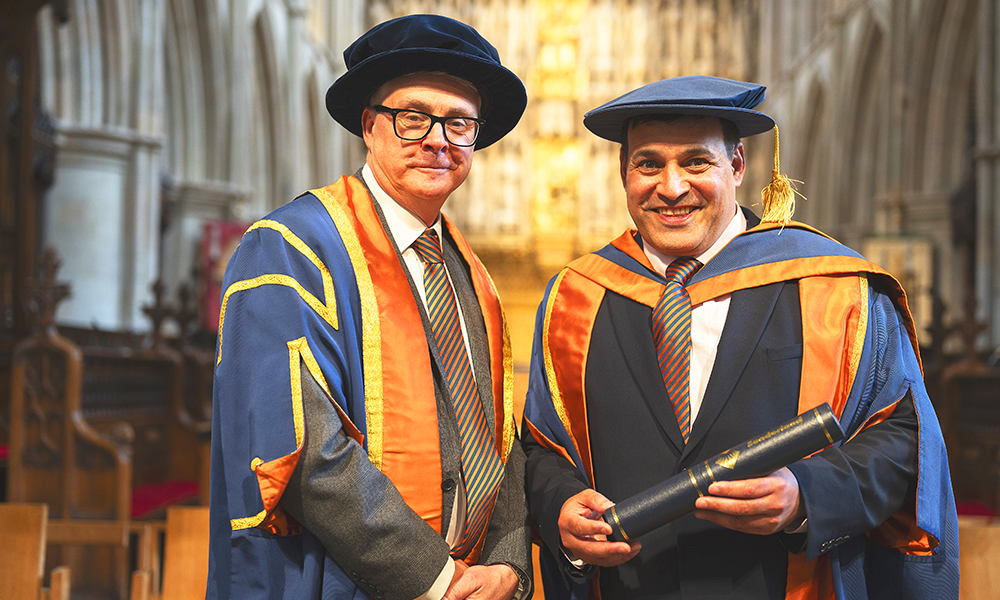
Image shows Alan Hardie and Jonathan Ganesh celebrating his honorary fellowship
Jonathan Ganesh with University Of Sunderland In London director Alan Hardie, left

the University Of Sunderland In London’s full citation

Before an assembly of students, their relatives, staff and guests, University Of Sunderland in London director Alan Hardie gave the following address:

Chancellor, vice-chancellor, and distinguished guests, ladies and gentlemen, I am privileged to present Jonathan Ganesh for the conferment of an Honorary Fellowship.

Our honorary guest today was born in Westminster in the late 1960s to an Irish mother, who worked as a chef, and a human rights lawyer father from Sri Lanka.

Jonathan spent his early childhood in County Limerick, leaving him with a deep connection to Ireland.

At the age of seven, he moved back to the UK, settling in the Docklands area.

Following his father’s ethos that “no education is ever wasted”, in the mid-1990s, Jonathan was studying law at college while working as a security guard in South Quay.

On February 9, 1996, though, Jonathan’s life changed forever as a result of the horrific IRA bombing of the South Quay Plaza building – which he described as “like being hit by a meteorite”. 

Despite facing life-altering injuries and a daunting mental and physical recovery, Jonathan was determined “to turn something bad into something very good”. 

Coming together with fellow survivors and their relatives, the need for ongoing support for bombing victims was clear and, in spring 1996, the Docklands Victims Association was formed.

For nearly 30 years, as the association’s honorary president and co-founder, Jonathan has led efforts in supporting and providing resources for victims and those affected by terrorism, in London and worldwide. 

The association has also lobbied government leaders to keep the rights of victims of terrorism on the agenda, as they can too often be forgotten once the media limelight fades. 

As a long-term Docklands resident, Jonathan remembers the South Quay area in the 1990s when it was mainly deserted docks.

Since then, he has witnessed its transformation into a commercial hub.

With the University Of Sunderland In London’s opening, in 2012, being praised by Jonathan for “enhancing the area’s social fabric and helping it thrive further”.

With a strong desire to support his local community during the pandemic, Jonathan became a volunteer NHS responder in 2020, collecting patients from hospital and delivering food and medication to local residents, which included fellow victims of terrorism. 

In recognition of these efforts, Jonathan received a Pandemic Response Medal in September 2023 – to which he can now add an Honorary Fellowship from the University Of Sunderland In London.

Chancellor, vice-chancellor, and distinguished guests, I present Jonathan Ganesh for an Honorary Fellowship.

Find out more about the university here and the Docklands Victims Association here

Read more: East Bank director Tamsin Ace on collaboration in Stratford

Read Wharf Life’s e-edition here

Subscribe to our free Wharf Whispers newsletter here
- Jon Massey is co-founder and editorial director of Wharf Life and writes about a wide range of subjects in Canary Wharf, Docklands and east London - contact via jon.massey@wharf-life.com
Subscribe To Wharf Life