
WaterAid Dragon Boat Race

The Music Is Black Festival brings East Bank partners together

Four free live weekends at the Queen Elizabeth Olympic Park, plus talks and film screenings have all been inspired by V&A East Museum exhibition
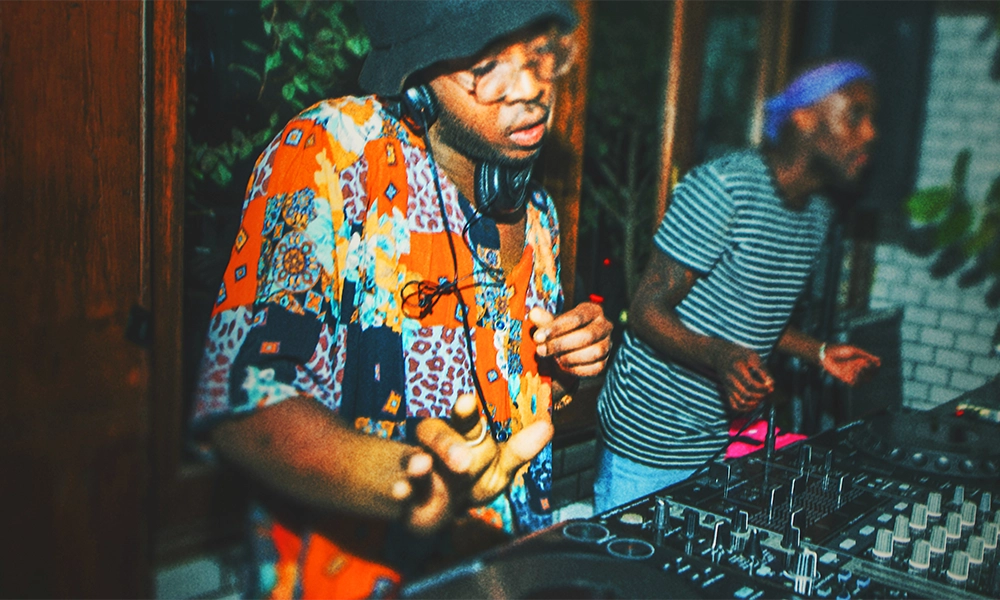
The Music Is Black Festival features four weekends of live performance including The Music Is Ours - image by Hangula Lucas
The Music Is Black Festival features four weekends of live performance including The Music Is Ours – image by Hangula Lucas

Subscribe to our free Wharf Whispers newsletter here

The collaborative promise of East Bank has been long in the making.

But now the wait is over.

V&A East, Sadler’s Wells East, UCL East, BBC Music Studios and the London College Of Fashion have all come together for the first time publicly to play their parts in The Music Is Black Festival in east London.

Essentially a creative response to V&A East Museum’s first exhibitionThe Music Is Black: A British Storythe programme includes four weekends of live gigs and performances as well as film screenings, talks, digital elements and exhibitions.

The aim is to reflect the breadth and depth of the impact made by black music in the UK.
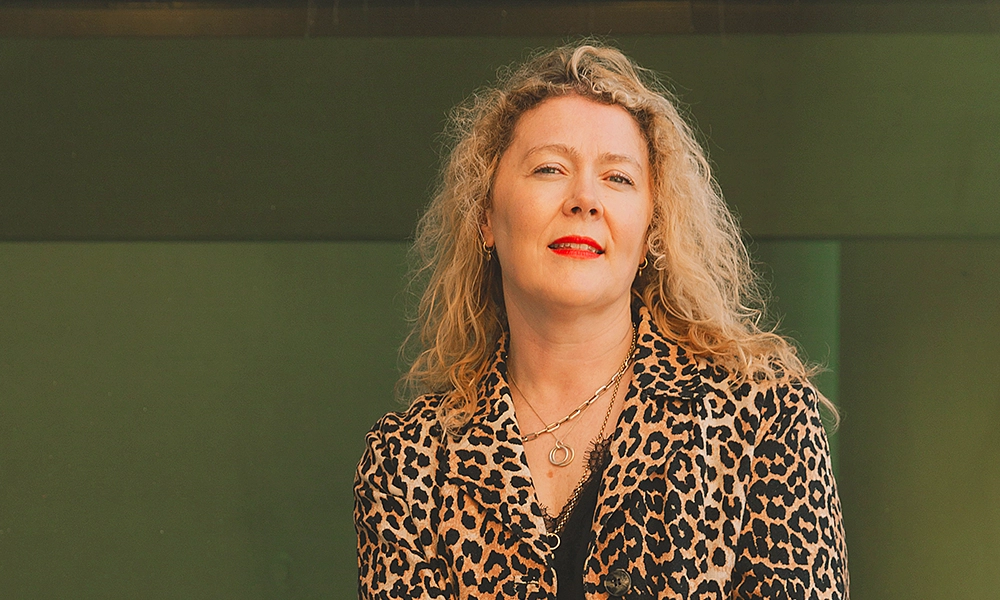
East Bank director Tamsin Ace - image by Christian Cassiel
East Bank director Tamsin Ace – image by Christian Cassiel

collaborating on The Music Is Black Festival

“Each of these five institutions have pivoted to respond to this theme and, layered on top of that, we have our programme of four live weekends – one each month,” said Tamsin Ace, director at East Bank.

“For example, the BBC has created The Music Is Black digital hub across TV, radio, iPlayer, Sounds and online to celebrate some of the key genres, personalities, scenes and compositions that define the last 125 years of black music in the UK.

“They’ve also created amazing educational resources through BBC Bitesize for secondary schools to use.

“It’s all been developed in collaboration with V&A East Museum.

“UCL East have organised a series of talks looking at black British visual culture, fashion – all kinds of different things – throughout the season.

“The London College Of Fashion is also hosting an amazing exhibition looking at sound system culture and designer identity.

“Then the four live weekends will bring people down to East Bank to celebrate the artists and musicians through free public performances.

“For these we’ve worked with an amazing curator, Gillian Jackson, and for each event we’ll have three stages – two right on the East Bank waterfront, with the Sadler’s Wells East public dance floor making up the third.

“The idea is we’ve got intergenerational dances, workshops and specially commissioned choreographed pieces, with live music, DJs and MCs.

“That’s the format we’ll follow for each of the weekends.”
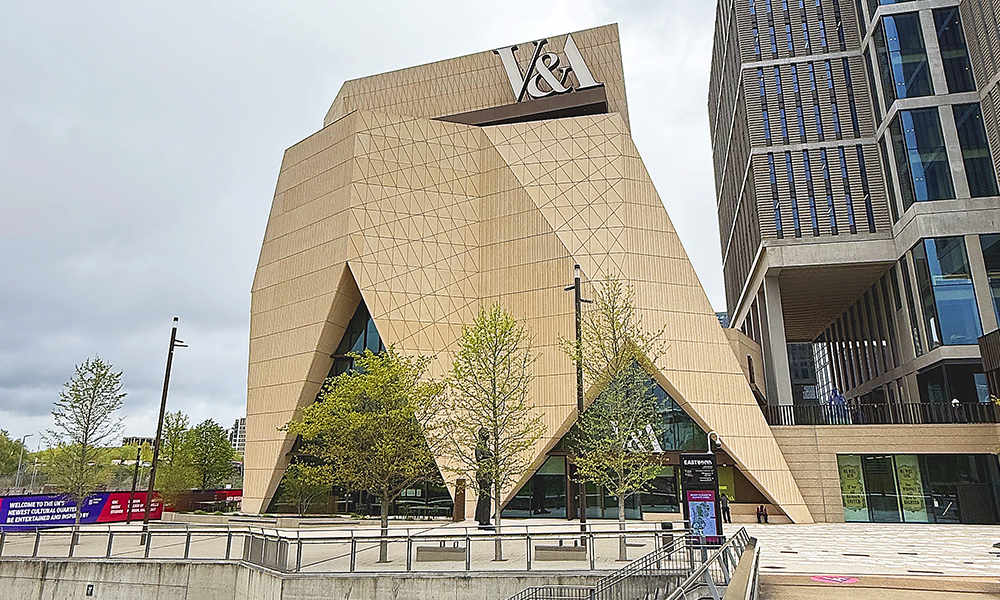
The festival is inspired by the V&A East Museum's The Music Is Black: A British Story exhibition - image by Jon Massey / Wharf Life
The festival is inspired by the V&A East Museum’s The Music Is Black: A British Story exhibition – image by Jon Massey / Wharf Life

The Music Is Ours

The live programme kicks off on June 13 and 14 with The Music Is Ours, featuring acts curated by Footsie, of grime collective the Newham Generals, on the Saturday and saxophonist and Soul Mama restaurant owner, YolanDa Brown, the day after.

Performers will include the likes of King Original, Tailor Jae, Nicole Blakk, My Runway Group, Acantha Lang and Melodees From Heaven.

Tamsin said: “We’re kicking off with a real block party, a celebration of east London’s huge contribution to black music.”

Sadler’s Wells East will feature Garage X Grime Reload curated by Kloe Dean on the first day with Breakin’ Convention taking over the dance floor on the Sunday for exhibition battles.
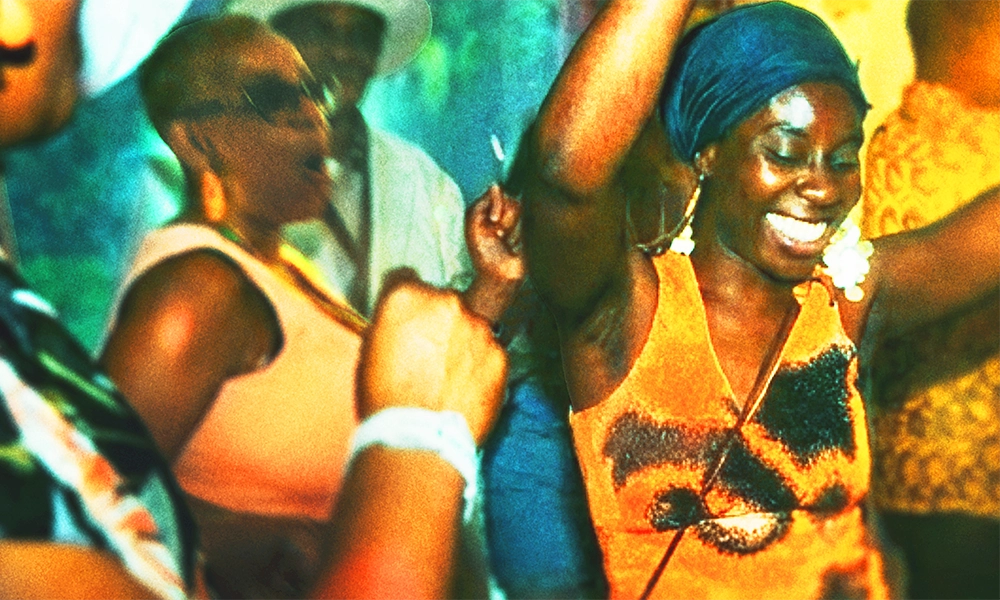
Power And Respect - image by Flashpop
Power And Respect – image by Flashpop

Power And Respect

Black women and non-binary people take centre stage on July 11 and 12 with Jamz Supernova on curatorial duties for the first day with Yaazmin Lacey and Tyson handling the second.

At Sadler’s Wells East, Jade Hackett’s Let Love Be Your Rock will showcase original group work set to lovers rock and reggae on the Saturday, followed by DJs L’attise Rhoden and Glade Marie the day after.

“This will have a different flavour and feel to it,” said Tamsin. “We hope people will come to all four of the weekends, but others may just pick one to attend.

“One of the things we’re really excited about is building that kind of recognition, that people will start getting to know that the Queen Elizabeth Olympic Park is a place where you can just turn up and bump into culture and creativity. We’re building that into a regular rhythm of free programming.

“We also know that people are hungry for moments of congregation and celebration and being in a joyful environment, and that’s what these free weekends will create.
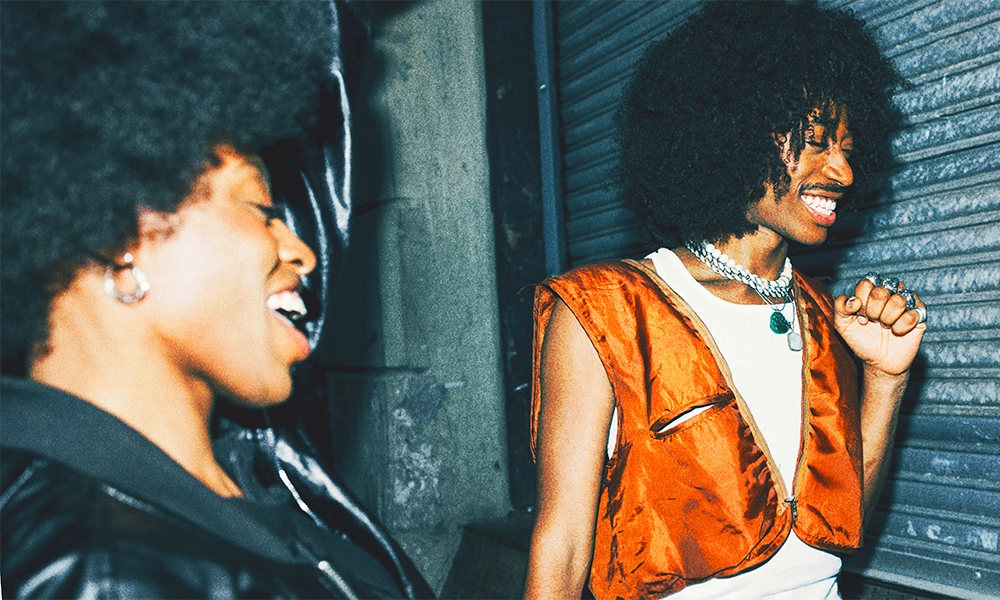
Queer Frequencies - image by Leo Patriz
Queer Frequencies – image by Leo Patriz

Queer Frequencies

Bringing together the queer collectives and communities that shape the rich tapestry of London’s queer scene, August 22 and 23 will be curated by Shy One, Donnie Sunshine, Mark-Ashley Dupé, Joel Mignott and Zinzi Minott.

Sadler’s Wells East will be blending dance with poetry and sound art alongside a pre-carnival party from Faggamuffin Bloc Party.

“This weekend is all about focussing on the huge contribution that queer creators have made to the scene, delivering a different vibe and energy,” said Tamsin. 
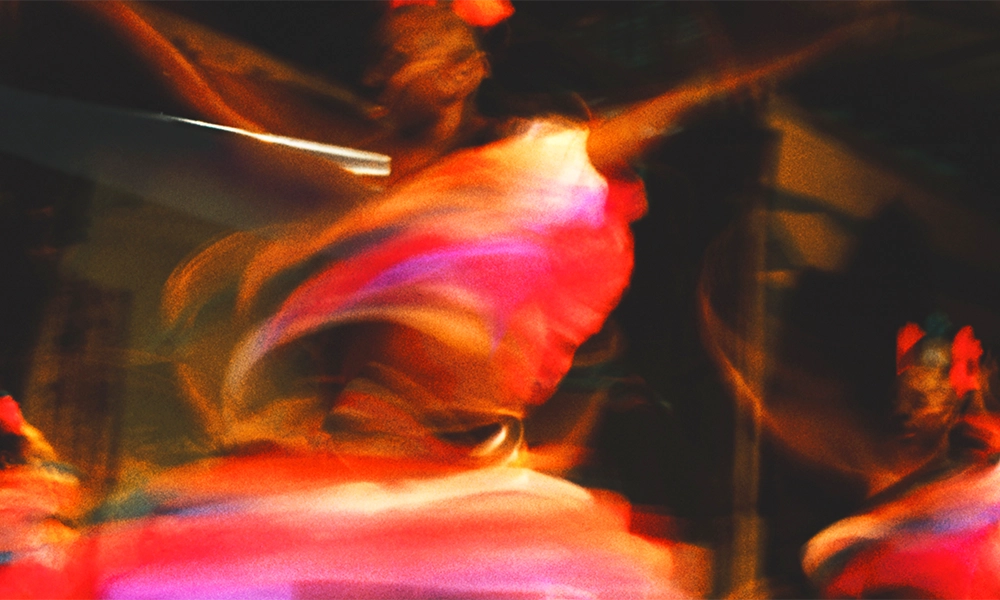
Black To The Future - image by Atlantide Phototravel
Black To The Future – image by Atlantide Phototravel

Black To The Future

“This is all about showcasing people who are really pushing the dial, bringing together different ideas and genres to mix things up,” said Tamsin. 

“We don’t know what the music of the future is, but these are some of the people who are imagining what it might be.

“What’s exciting about it is that there are people right now, in their studios and bedrooms, in their youth centres and their schools, creating sounds we have not even heard yet.

“That’s what east London has done so brilliantly over so many decades.”

Taking place on September 12 and 13, the final live weekend features curation from Flohio, The Blues Project and Dannielle ‘Rhimes’ Lecointe.

It’s hoped that the festival will form something of a blueprint for future years with East Bank’s members continuing to collaborate.

“It feels like a significant moment for the project,” said Tamsin.

“It’s amazing to see the momentum and we’re supporting 20 jobs for east Londoners to help deliver the festival programme.

“The ambition is to build a corps of freelancers that East Bank can tap into and invest in – a pipeline of local creative talent and that’s so important.”  

key details: The Music Is Black Festival

The Music Is Black Festival runs from June 13 until Sept 13, 2026, and includes four free weekends of music.

Full listings and booking details for events (where appropriate) can be found here

Read more: Whole Foods Market opens its doors in Canary Wharf

Read Wharf Life’s e-edition here

Subscribe to our free Wharf Whispers newsletter here

Subscribe To Wharf Life

Rewilding Healthcare draws maritime metaphors together at UCL

Art installation as part of UCL East Marshgate’s A Place Of Our Making exhibition connects community, water and art at East Bank in Stratford

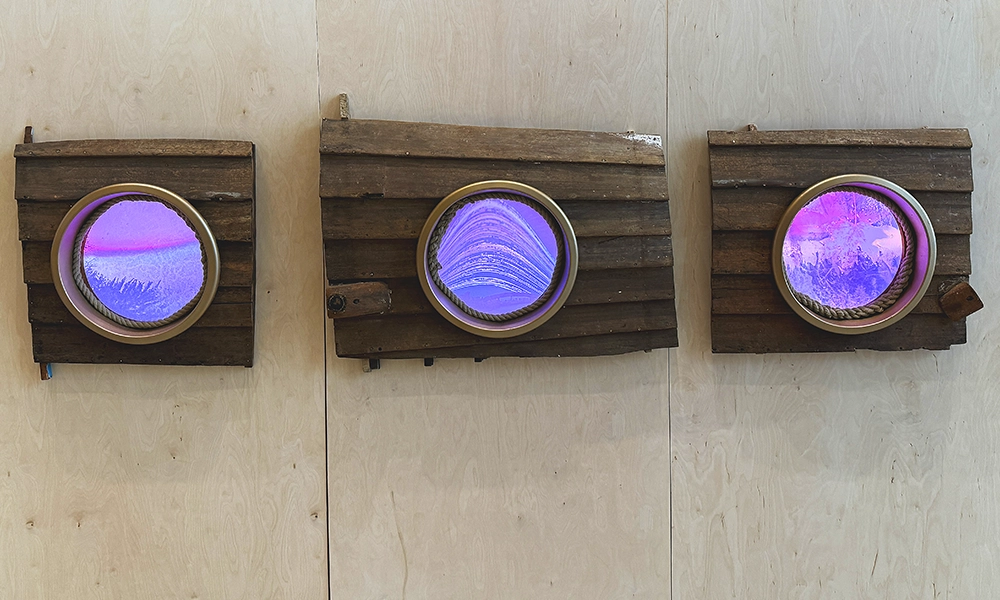
Part of the Rewilding Healthcare exhibition at UCL East Marshgate - image by Jon Massey
Part of the Rewilding Healthcare exhibition at UCL East Marshgate – image by Jon Massey

Subscribe to our free Wharf Whispers newsletter here

The public is invited to UCL East Marshgate – the university’s Queen Elizabeth Olympic Park campus that forms one fifth of East Bank – over the next few weeks to experience five installations.

A Place Of Our Making: A Multisensory Exhibition About East London showcases the work of five partnerships between artists and UCL researchers, who have collaborated with east London residents for a project aimed at exploring ways to improve the lives of those in this part of the capital.

Free to view and experience, visitors can shake the hand of a seven-foot puppet and smell a bagel brick, amongst many other sensory wonders.

The installations have been created through UCL’s Trellis programme, which pairs up academics and creatives.

The breadth and scope of this fifth iteration of the scheme is too great to be comprehensive here, so instead we sat down with artist Laura Copsey, who teamed up with associate professor of palliative medicine in the Marie Curie Palliative Care Research Department at UCLH, Sarah Yardley, to create Rewilding Healthcare.

Central to their collaboration is water and its use as a metaphor for patients and those working in the care sector. 

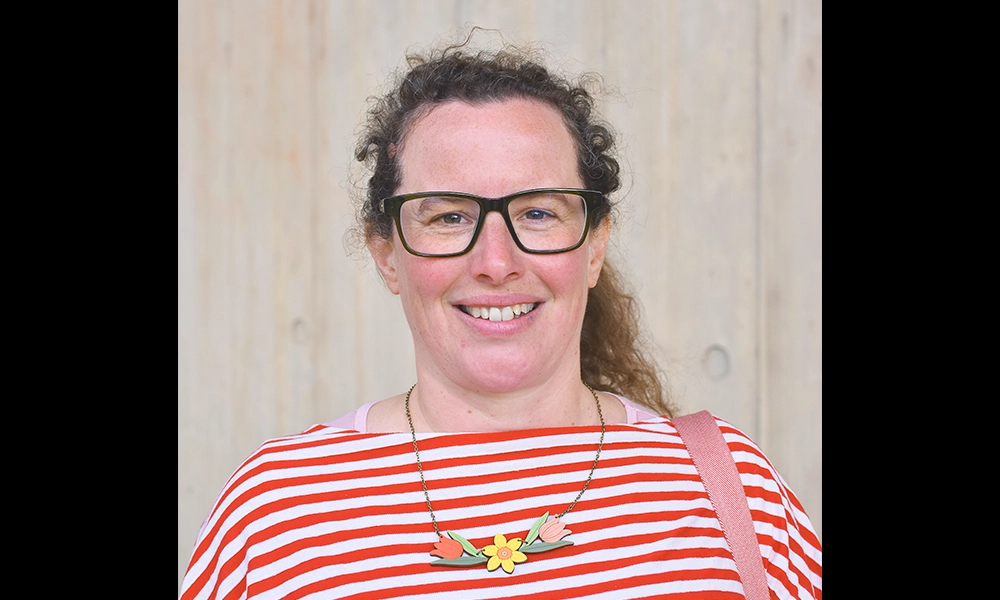
Associate professor of palliative medicine in the Marie Curie Palliative Care Research Department at UCLH, Sarah Yardley - image by Jon Massey
Associate professor of palliative medicine in the Marie Curie Palliative Care Research Department at UCLH, Sarah Yardley – image by Jon Massey

Rewilding Healthcare: an investigation

“I’m always trying to investigate how we can make things better for people by being authentic and meeting people’s needs,” said Sarah.

“My research is about gaps between expectation and experience.

“When we were sounding out ideas with each other, we discovered we both had a love of sailing and all things maritime and nautical – the project really progressed from there.

“I am a sailor, but the metaphor came from some of my research – a study on how we conceptualise ideas of safety, risk of harm and what success looks like for people who needed palliative care and those with severe mental illness.

“Through that work, I interviewed and observed many sides of the healthcare system and I brought the study to Laura.

“Carers would talk about uncharted waters and stormy seas, while patients would talk about how it was impossible to navigate the system.”

Laura said: “We found common ground straight away because the work I do as an artist is generally very watery.

“I grew up with my dad who used to run a ferry on the River Deben.

“I describe myself as an illustrator of stories, but my pieces don’t tend to look like things people usually think of when they hear the word illustration.

“They’re more like a collection of objects that communicate meaning.

“You could call it a disembodied comic with lots of different fragments. I call it ‘hydro-fiction’.”

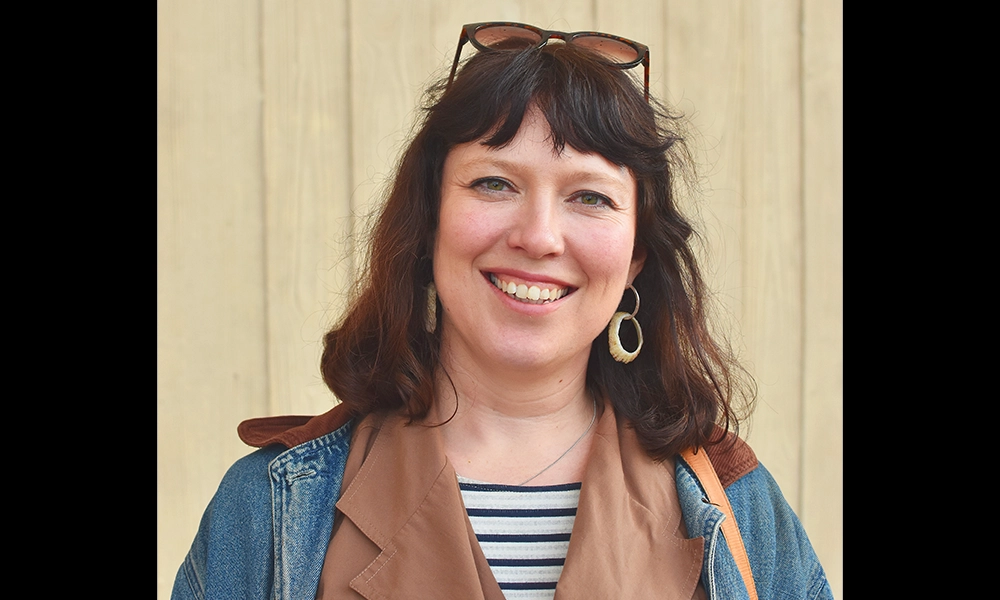
Artist Laura Copsey - image by Jon Massey
Artist Laura Copsey – image by Jon Massey

a multitude of metaphors

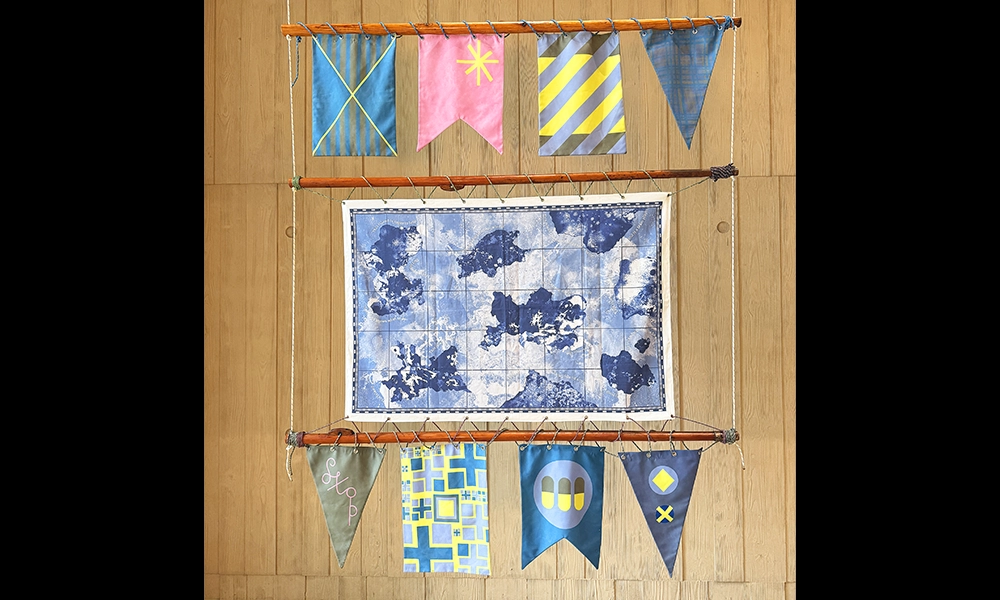
In the case of Rewilding Healthcare, the display includes images in portholes circled with rope, sewn flags and a fabric map suspended from sections of a boat’s mast, a reimagining of the Shipping Forecast, a specially created newspaper, an altered life preserver and even postcards for viewers to express their thoughts.

All have been made through collaborative workshops at ecological regeneration project Cody Dock, just down the Lea from UCL East Marshgate

“We ran sessions monthly, each with a different theme,” said Laura.

“They were aimed at trying to start conversations about health based on Sarah’s research.

“We sewed to make signal flags, created boats, made collage, drew and took photographs.

“It was an experiment to see what sorts of activities would generate conversations – it turned out that pretty much all of them did.

“What people will see in our part of the exhibition are things you would associate with safety, but layered with new meaning or made to look a bit unusual.

“I hope our audience will see them as familiar, but then ask why they’re presented in this new way and what that could mean.

“Much of the work is subtle or works on multiple levels – waiting room chairs upholstered to look like rocks, for example.”

Part of Rewilding Healthcare at UCL East Marshgate featuring photography and materials from Cody Dock - image by Jon Massey
Part of Rewilding Healthcare at UCL East Marshgate featuring photography and materials from Cody Dock – image by Jon Massey

sparking conversations

Laura and Sarah had help from playground creator and APE director, John O’Driscoll, who is based at Cody Dock and supplied nautical props to assist with the project – helping make the maritime metaphors flesh.

“We were surprised from the very first workshop to see how the symbolism all this stuff – buoys, fenders, anchors – had with regard to people’s experience of healthcare,” said Laura.

“The conversation was rich. Initially I thought the experiment would be hard, but people got it immediately.”

Sarah added: “There were about 45 participants in total – some dropped in and out and around 10 were with us from start to finish.

“There are many layers and metaphors in what we’ve created together.

“Using nautical and maritime language expresses something about healthcare systems in a different way and we hope that this will allow people to open up and express what they think about their own experiences.

“All the way along, people have said to us that these are difficult conversations, which can be distressing, but we absolutely need to have them.

“For some people, Rewilding Healthcare might carry a really personal meaning, but for others – including medical colleagues – it could be to ask themselves what they can do to create the meaning people are looking for.

“When we do a workshop, I say to people, imagine we’re a lifeboat crew and we’re all together.

“On an island – and thinking about archipelagos has been a big part of the  project – if the sirens go off, we’re all part of the crew.

“Sometimes you’ll be the person needing to be rescued, sometimes you’ll be the rescuer, but it will create a real dialogue.”

Laura added: “There are so many parallels between sailing a boat and healthcare. You have to work together and you need people with different skills, but you’re also at sea and you can’t control the weather.

“There are risks, but it’s often positive risk-taking.” 

key details: Rewilding Healthcare at UCL East

A Place Of Our Making: A Multisensory Exhibition About East London features Rewilding Healthcare and is on show at UCL East Marshgate until April 13, 2025.

The show is open from 10am-6pm daily and is free to visit. The exhibition is also open until 8pm on Thursdays.

A series of workshops are set to be held focused on specific exhibits.

Find out more about the exhibition and events here

Read more: How Green Pioneer could be the future of decarbonised shipping

Read Wharf Life’s e-edition here

Subscribe to our free Wharf Whispers newsletter here

Subscribe To Wharf Life

East Bank director Tamsin Ace on collaboration at Stratford campus

How Sadler’s Wells East, London College Of Fashion, UCL East, BBC Music Studios and V&A East are coming together at the cultural hub

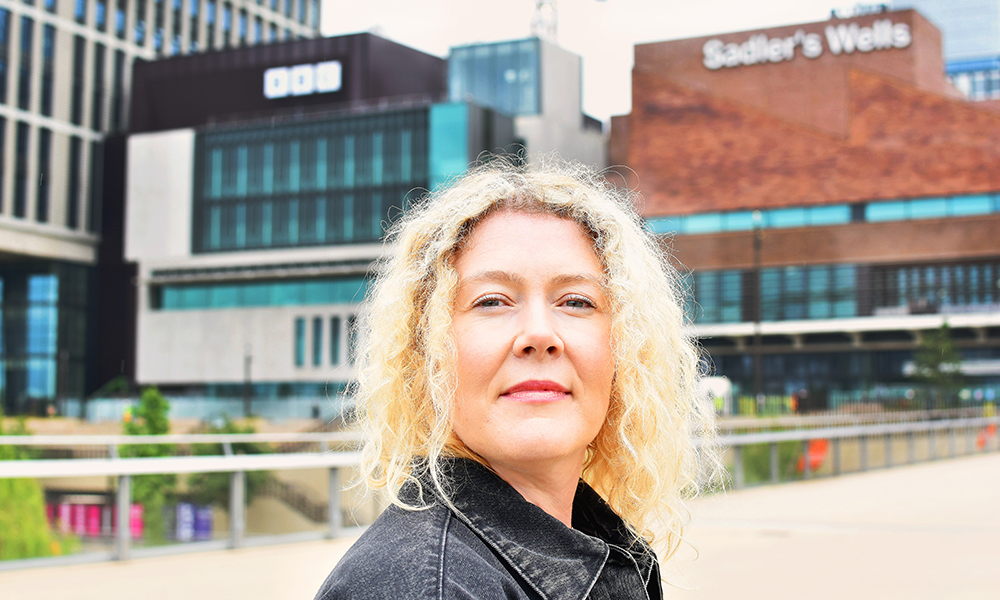
Image shows Tamsin Ace, a woman with curly blonde hair in a black denim jacket in front of buildings at Stratford's East Bank
East Bank director Tamsin Ace

Subscribe to our free Wharf Whispers newsletter here

East Bank is, arguably, the final great piece in Stratford’s Olympic legacy jigsaw.

Comprising significant bases for five totemic institutions, it’s set to be fully open by the end of 2025 – 13 years after the 2012 Games put east London in the global spotlight.    

Building on the successes of the Queen Elizabeth Olympic Park – including all the former sports venues and the extensive residential and commercial regeneration that has taken place locally – East Bank delivers something different for the area.

Even if just one of the London College Of Fashion, the V&A, the BBC, Sadler’s Wells and UCL had chosen to create a new base in Stratford, it would have been seen as a triumph for the architects of the Games.

That all five are committed to the project gives East Bank a kind of cultural and educational heft that hasn’t been seen in the capital for decades.

With four of the organisations sitting proudly overlooking the park on the edge of the River Lea and UCL a short walk away, the concentration of is palpably powerful.

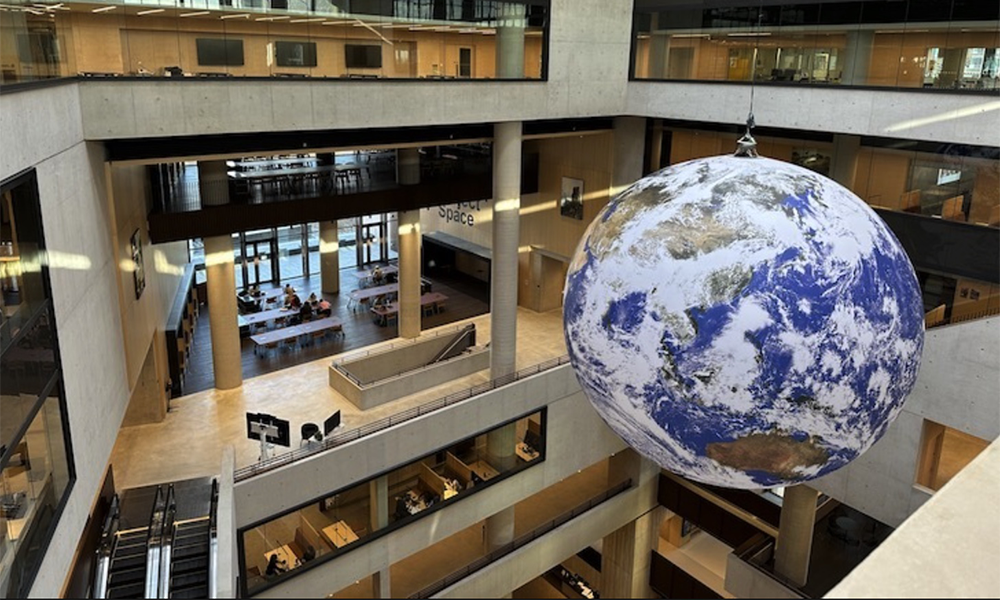
Image shows a sculpture of the Earth hanging inside a large concrete atrium at UCL East on the Queen Elizabeth Olympic Park
UCL East is now fully up and running

greater than the sum: East Bank

There’s a wealth of potential for collaboration and interaction between the five, but the project isn’t leaving things to chance and happenstance.

Tamsin Ace arrived as director of East Bank in September last year – more or less at the same time the London College Of Fashion began welcoming staff, students and visitors to its new campus.

With UCL East also fully open and Sadler’s Wells East set to launch later this year, it’s her job to help maximise interaction between the organisations for the benefit of all – cementing the cultural legacy of the Games.

“My role is to support and enable all these institutions to come together and to make sure they build on each other’s ideas and resources, while also thinking about how they can connect better,” she said.

“It’s a gift, because all of these partners want to be here and to connect.

“They all want to put down roots and have a home in east London, to listen and learn from the amazing heritage and history of the creative communities that have been in this area long before East Bank was even a twinkle in London’s eye.

“To do that I have the full support of the project’s board, which is made up of the principals of the five main partners.

“I’ve got a pass to all of the buildings so I can work from any of them and also understand their programmes and the different ways they work.

“We have creative working groups to discuss opportunities and plans, so my job is to have my ear to the ground, to know what everyone’s thinking and planning.

“It’s also to be out in the community, being really visible, talking to people and hearing what their priorities are so I can help create links.”

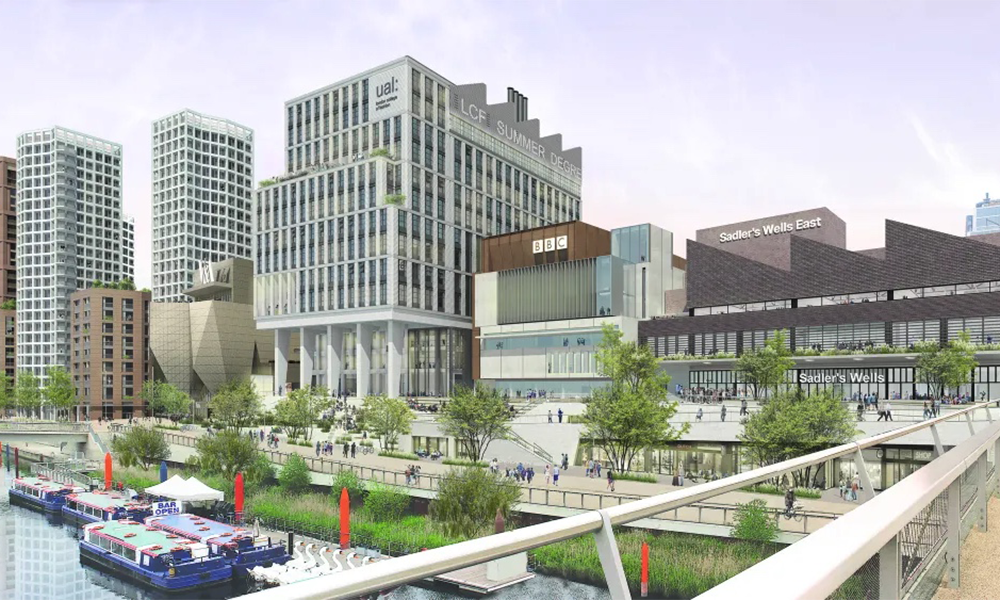
Image shows a computer generated picture of the London College Of Fashion, V&A East, BBC Music Studios and Sadler's Well's East at East Bank
An artist’s impression of how East Bank will look when work is finished

cultural programming

Having studied drama at university, Tamsin initially headed for the classroom after realising that acting and “being a Spice Girl” weren’t really for her.

But life as a teacher wasn’t right either and she wound up working for small arts centres instead.

“I was engaging with children and young people and through that found out about this kind of role – developing ways to get different audiences involved and to unlock and learn from their creativity,” she said.

“I love it when the magic comes together and something you hadn’t thought possible is created.”

After more than a decade doing just that at the Southbank Centre – “implementing festival methodology to create the feel of a bustling port city at arts venues by programming around central themes” – and roles at the Museum Of The Home in Shoreditch and at the London College Of Fashion, she’s come to East Bank to help fulfil its 2012 legacy promise.

“All five of our institutions have got public-facing programmes and my job is to connect the dots,” she said.

“We’re all talking all the time. It’s about collaboration, sharing resources and ideas, and it’s also about embedding ourselves in the community.

“It’s also about being open with our priorities and aims, and properly connecting with people who are living and working here.

“Over the last seven years, the organisations have all been building links with key partners such as schools to build programmes that respond to the needs and values of the people locally.

“Ultimately, we want visitors, students and staff to be able to navigate East Bank’s five buildings and understand how they connect to each other.

“In 10 years’ time I would love to see large-scale programming across all of the organisations that builds on their amazing creativity and skills.”

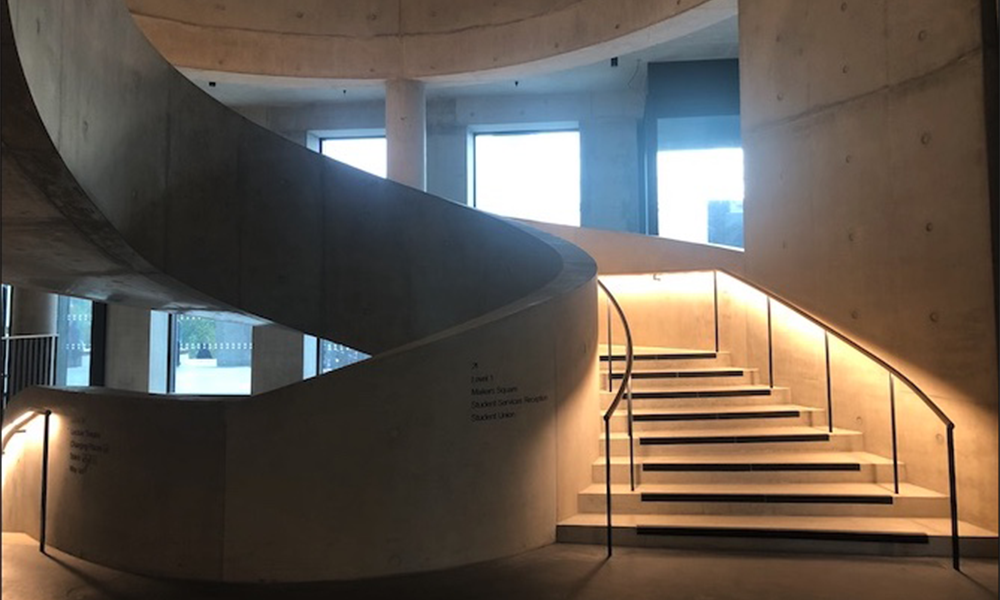
Image shows a curved concrete staircase at the London College Of Fashion in Stratford
Students and staff are already enjoying the London College Of Fashion’s new base

a new hub for creativity

“I think this place can be as successful as the Southbank Centre – there will be enough for everyone here – but I think they are two very different offers,” added Tamsin.

“There’s a magic about coming to this part of the city with its busy, bustling shopping experience at Westfield and then East Bank for culture and creativity.

“I think if we get the local story right and have a programme that is relevant to the community then we’ll get the world right too.

“Tourists will come because they want to feel they are part of events that really do mean something.”

While University College London and the London College Of Fashion are up and running, something of a watershed moment is coming for the project with the opening of Sadler’s Wells East later this year.

“That will be the first of our cultural partners to have an offering as part of the night-time economy and it will be really exciting to see how the evening shows and workshops change this space,” said Tamsin.

“Sadler’s Wells has also got its hip-hop academy opening, so we’ll have 16 to 19-year-olds learning and practising on-site.

“The building has been designed with an outside and inside feel, so we’re hoping people will get the idea of dance tumbling out into the public realm and people will come to see the next generation of dancers performing or warming up.

“I’m really excited about this summer because this is the time we’re really starting to build that  excitement and buzz – that East Bank is a place you can come and bump into amazing art and ideas.

“It’s a bit of a taster of what’s to come as we build and grow towards total opening by the end of 2025.

“It’s exhilarating and I can’t wait to see how it feels when all five organisations are open. 

“You might be walking from UCL over to the Stratford waterfront and know you’ve got a BBC orchestra rehearsing in one of the studios, a big exhibition at V&A East, dancers performing on the community dance floor outside Sadler’s Wells East and a fashion show being cooked up at the London College Of Fashion. 

“I want everyone who comes here to feel that same sense of excitement and pride we all felt around the 2012 Games themselves.”

Image shows a dancer dressed in black interacting with a staircase ahead of Greenwich + Docklands International Festival in Septemeber
Greenwich + Docklands International Festival is set to come to Stratford in 2024

coming up at East Bank

This summer is when things really start to happen at East Bank in 2024.

Activities kick off with the Great Get Together on June 15 – a free community event at the Queen Elizabeth Olympic Park with activities spanning music, dance, arts, sports and, naturally food.

Then, there’s the UCL Festival Of Engineering on July 15, a celebration of 150 years of advancements in technology, problem solving and creating things.

July will also see London College Of Fashion students present their work, with an exhibition at the East Bank campus, while V&A East will unveil its Made In East London commission – artworks that will be displayed on its exterior.

August is all about the hip hop, with breaking sessions at Sadler’s Wells East scheduled for 3, 5-8 and 9-10. 

Then, September 7 sees the Greenwich + Docklands International Festival pitch up at neighbouring Stratford Cross with its Dancing City programme.

Find our more about the campus here

Read more: How Third Space has expanded its offering at Canary Wharf

Read Wharf Life’s e-edition here

Subscribe to our free Wharf Whispers newsletter here
- Jon Massey is co-founder and editorial director of Wharf Life and writes about a wide range of subjects in Canary Wharf, Docklands and east London - contact via jon.massey@wharf-life.com

Subscribe To Wharf Life