

UK premiere of lauded American show tells the story of a mysterious photo album featuring Nazis working at Auschwitz concentration camp
Subscribe to our free Wharf Whispers newsletter here
“A lot of people asked us early on if, by making a play about Auschwitz, we were humanising Nazis,” said Matt Joslyn, executive director of Tectonic Theater and producer of Here There Are Blueberries.
“It’s an interesting question, because we don’t have to humanise them.
“They are human – the danger is to dehumanise them.”
The play, a Pulitzer Prize finalist that has garnered widespread recognition over a series of runs in the States, is set to get its UK première at Stratford East with shows from January 31 until February 28 ,2026.
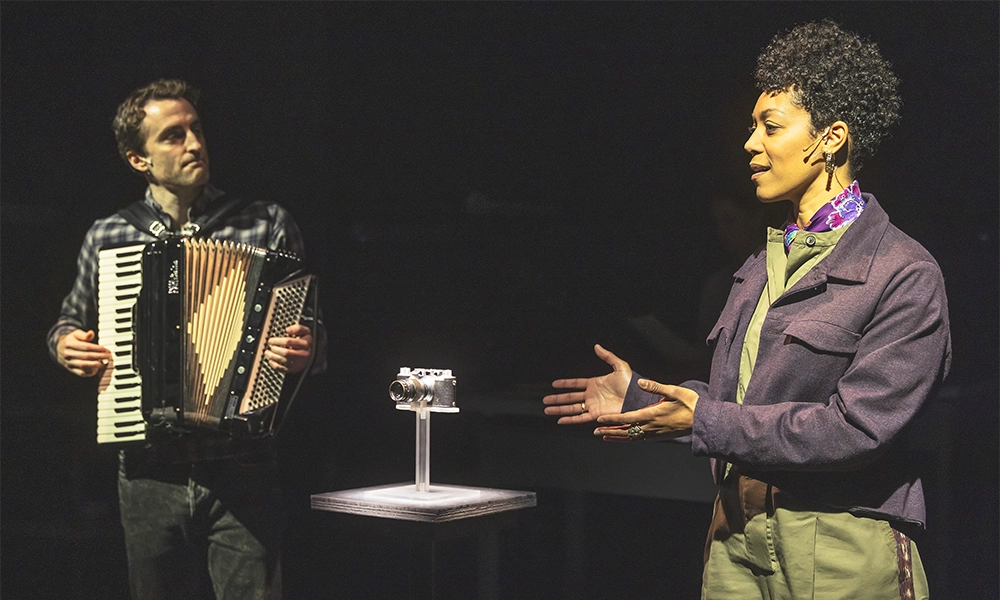
It tells the story of a mysterious photo album that arrived on the desk of a US Holocaust Memorial Museum archivist’s desk one day in 2007.
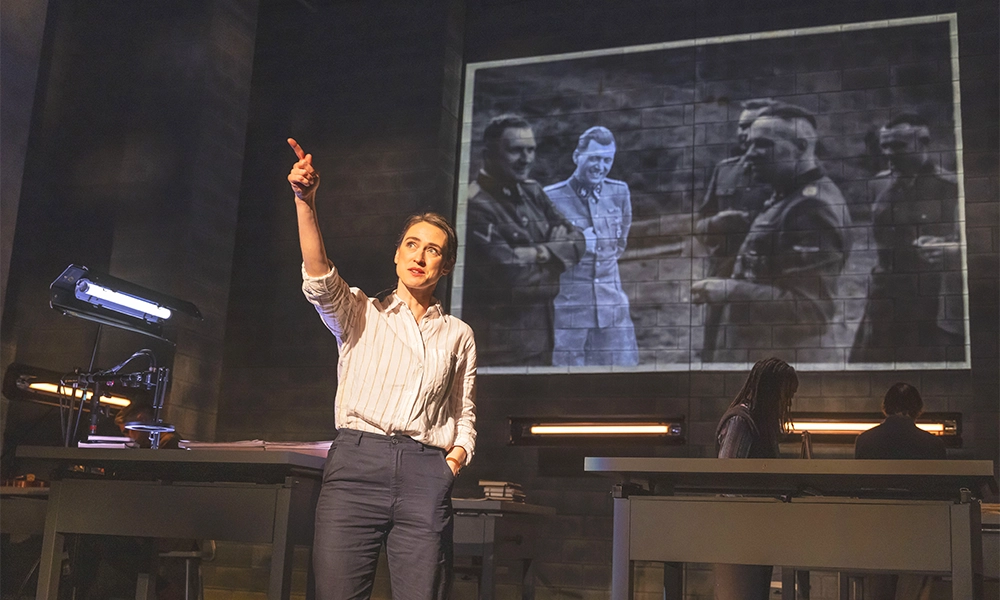
Inside are what Matt describes as “Nazi selfies” – photos taken by and of those working at the Auschwitz concentration camp complex.
The piece takes its name from a handwritten caption in the album – “hier gibt es blaubeeren” – beside a photo of young women and a man enjoying bowls of blueberries, while another man plays the accordion in the background.

the story of a play
“The journey of the play really began in 2012, when Moisés Kaufman – its co-author – saved the front page of the New York Times with a photo that haunted him,” said Matt.
“It sat on his desk for three years before he wrote to the museum archivist.
“They were originally going to meet for half an hour, but ended up spending three days together.
“It was during that time Moisés began to realise the possibility of a play was in the fact that uncovering the history of the album and its images was a detective story.
“It was about asking what this enigmatic object is and why it’s so strangely compelling and powerful.
“He was drawn to the images, but also to how the archivist untangled the tale of who made the album, what it depicts and what the people featured were doing.
“It’s important to note that we considered whether the world needed another Holocaust play.
“The atrocity has been the subject of more works of art – plays, books and films – than any other event in human history.
“But this album did have something different to say – among other things raising the question how people could eat blueberries next to a concentration camp where 1.1million people were being murdered?”
Presented by Tectonic, the play was conceived and directed by Moisés who wrote the piece in collaboration with Amanda Gronich.
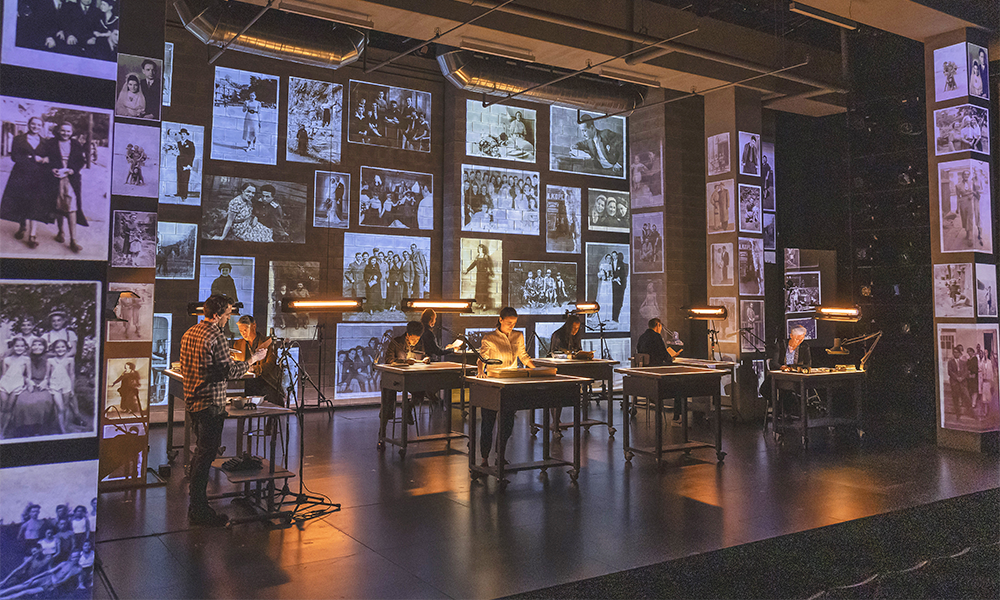
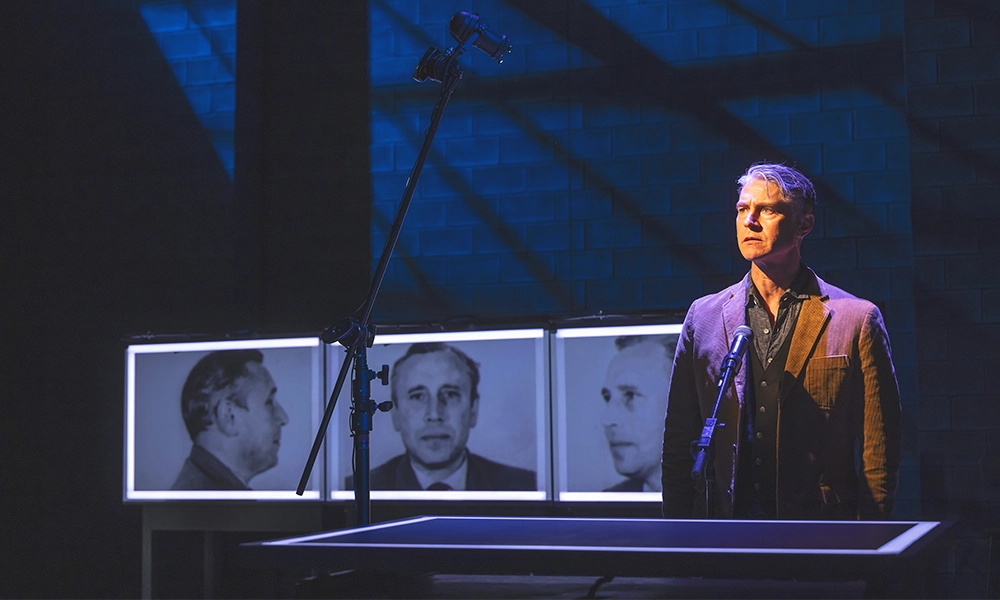
Newly cast for its London run, the show features hard-hitting projections on stage as it explores the issues raised by the album’s arrival.
Tectonic Theater’s Matt Joslyn – image supplied by Here There Are Blueberries / Tectonic Theater
complacent, complicit, culpable?
Matt said: “What drew us to the development of the play in earnest was about six years of research, interviews and workshops.
“A lot of this was with second and third generation survivors and perpetrators of the Holocaust – investigating the inherited trauma on both sides.
“We began the work in 2016, which future historians may well point to as a shifting point in the world.
“We were starting to contemplate what ways each of us are complacent about terrible things that happen, as well as complicit in them and sometimes even culpable for them.
“In many ways you could look at and study this play as a meditation on that continuum.
“What the play is really trying to do is to encourage audiences to contemplate their own role in the world – whether they are contributing to the suffering of others or willingly doing something that’s causing harm.
“This, for me, is the central point.
“Growing up, I was consistently told things that made me feel safe about the Holocaust – that the people who did it were monsters, that individuals were brainwashed or tricked into taking part.
“The truth is the perpetrators of Auschwitz had similar upbringings to mine, growing up in the American Mid West with similar values.”
beyond the performance
To help audiences get to grips with these issues, Here There Are Blueberries is presented as more than a play.
A series of post-show talks will be hosted on selected dates during the run to discuss themes raised by the production.
Those who have bought a ticket for any of the shows at Stratford East can attend these, even if they haven’t seen the play that day.
Matt said: “One of the things that has surprised and gratified us about the play is that it does elicit a powerful response, which leads to audience members wanting and needing to talk about it.
“It’s something we piloted when the play had its première in San Diego in 2022 and we’ve done them ever since.
“Most are curated by Fellowships At Auschwitz For The Study Of Professional Ethics.
“There’s a phenomenal quote from FASPE’s founder, which is that the story of Auschwitz is the story of problem solving.
“If you understand that, you can understand how it happened.
“When we visited the camp as part of this project, we were taken down a long path between the men’s and women’s huts on our way to the birch trees at the back where people waited to be taken into the gas chambers.
“On the way, I noticed a cistern on stilts and I asked our guide what it was for.
“He told me it was for fire suppression because the insurance companies required it.
“I was brought up to believe that all the camps were criminal enterprises.
“To contemplate an insurance adjuster with a clipboard, coming to the camp, where 100,000 people were imprisoned, and authorising the cistern so the buildings and the prisoners’ lives were insured, was a shocking thing for me.
“The talks centre around such questions as why the Holocaust is still a subject of study, its normalisation and reflection on the humans’ capacity to project normalcy in the face of the extraordinary.
“Personally, in the US, I experience that every day in terms of what’s happening in our politics.
“We’re hoping to respond to the need for people to talk more about the play and then connect them to a wider world.
“We hope it sends people in different directions, to learn more about the camps, the fact women were very much involved in running them, the fact doctors did awful experiments and the businesses that took part in the forced labour enterprise.”
key details: Here There Are Blueberries
Here There Are Blueberries is set to run at Stratford East from January 31 until February 28, 2026 with performance times varying.
Tickets start at £10 for most shows.
Find out more about the production or book tickets here
Read more: Orbit Clipper begins carrying ferry passengers between Rotherhithe and Canary Wharf
Read Wharf Life’s e-edition here
Subscribe to our free Wharf Whispers newsletter here
