

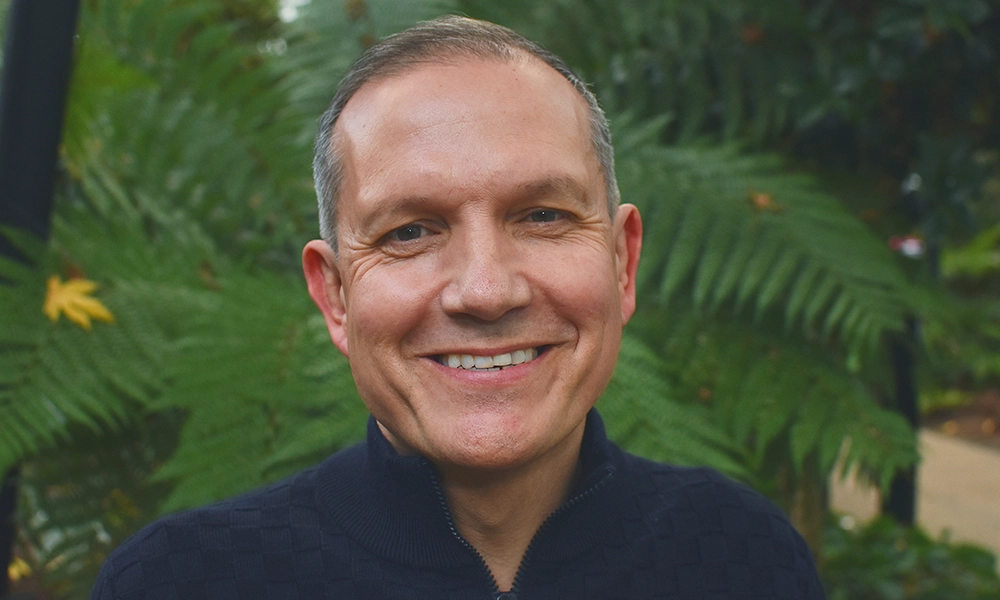
Founder and CEO of the Canary Wharf-based business, Chris Ezekiel, explains how his firm’s approach is proving attractive to larger organisations
Subscribe to our free Wharf Whispers newsletter here
It feels like a big year for Chris Ezekiel.
Not only is he gearing up to become a father for the third time – a sibling is on the way for sons Matthew and Harry – but Creative Virtual, the company he founded on the Isle Of Dogs 22 years ago, recently went live with a hybrid human and AI system to help Australia’s largest mobile network better deal with its customers.
“We think it’s a world first,” said Chris, who still lives locally despite running the global business as its CEO.
“Our project with Telstra sees a large enterprise using conversational AI and chatbot technology in a public-facing way – a hybrid approach with all the appropriate guardrails in place.
“There are other companies doing this with AI, but only on a small scale.
“We spent the best part of 2025 building the system and linking it in to all their operations.
“It’s all about knowing when to give a generative answer, something more structured or a combination of the two.
“Our system also does things like summarising, classifying and making all these decisions in real time.
“I’m very proud that we’ve displaced two of the world’s largest companies in this field – IBM and Salesforce – to deliver this solution.
“As soon as Telstra switched it on they doubled their containment rate, which means twice as many interactions have been automated rather than going through to a human in their contact centre.
“Now we have a road map to do much more over the course of the next 12 months.
“Our system is going to be the central point of communication for all their interactions with existing clients and potential customers – all with a clear escalation path for more complex queries or situations.
“There’s always going to be a need for that.”
beyond ChatGPT
Chris said that, while the arrival of ChatGPT in 2022 and the subsequent proliferation of large language models that generate responses had been significant for the sector that Creative Virtual operates in, many firms had done little in the way of implementing the technology.
“People have this perception that computers have to be 100% accurate, or the job they do is not acceptable,” he said.
“If a human makes a mistake, it often doesn’t get the same level of attention as a machine failing or given an answer that’s wrong.
“As a result, many larger organisations were paralysed when it came to putting new systems in place.
“During this time, we stuck to our guns and did what we’ve always done – tune into what organisations really want.
“That’s what’s brought us success. We’ve kept humans in the system to curate answers, working alongside generative AI and other technologies, meaning we can combine their talents when communicating with customers – something that’s reassuring to large organisations such as banks or telecommunications firms.
“With these clients there’s a large number of processes that their customers need to go through – billing enquiries or applications for accounts and credit cards, for example.
“These need high levels of curation and can’t be left to AI.
“That’s why clients like our approach. They can have very tightly controlled parts of the process alongside the simpler enquiries that can be dealt with by AI.
“Our tagline remains completely relevant today – we’re about the science of conversation and finding the best ways to automate those interactions whether that’s via chatbots, texts, WhatsApp or Facebook Messenger.
“We’re still doing that, but using the latest techniques.
“Our project with Telstra – all that hard work – has resulted in a big global showcase for Creative Virtual.
“We have built some bespoke systems for the client, but many of our standard techniques are ready to scale for other organisations.
“One of the most important elements is the expertise to understand what this technology can and can’t do – what you can measure and how to set an organisation’s expectations.
“Having this blueprint as we go into 2026 is absolutely key for our business.”
designed to be flexible
Creative Virtual has built its approach to conversational interaction around the idea that it can rapidly and easily switch out AI systems to benefit its clients as the technology develops.
However, Chris believes that while the sector is showing advancement in several areas, it is important to recognise its limitations.
“There are some very clever people in the industry who claim that we’ll have artificial general intelligence very soon, that computers might even become sentient,” he said.
“But we don’t even understand human intelligence at this point.
“You have to take a step back and recognise all these new systems such as large language models are still based on silicon chips – ones and zeros – backed by incredible processing power, but a model that hasn’t changed since the invention of the computer.
“With quantum computing, biological systems or a combination of the two, it may be possible for AI to do a great deal more, but will it become self aware, will it be able to feel things?
“I think its impossible to say that our existing computer models will take over the world.
“I’m not arguing that we haven’t seen advances in systems that can predict the next word or phrase or that these engines can’t simulate intelligence or awareness.
“But that to have emotions the computers that run them will need more than ones and zeroes.
“I’m sceptical that artificial general intelligence is just around the corner, even if discussing it makes for a good story in the media.”
doing more and more jobs
One thing Chris is certain of is that AI technologies will be increasingly used to automate large parts of our lives.
“AI will do many of the jobs humans do today and robotics will come increasingly into play, such as self-driving cars,” he said.
“It is going to be an exciting area and AI is already being used to help doctors with diagnostics and to process large volumes of data in many different fields.
“That’s how we use the technology, for customer services, training virtual sales people and bringing our systems into the retail experience.
“There will be robots in stores capable of retaining far more information about products on sale than a human ever could, for example.”
That’s not to say AI is perfect or that the large companies involved in developing new models aren’t overly optimistic about the value of their creation.
“With all the billions being invested, there is, perhaps, a bubble – but AI is not going to go away as a tool, just as the end of the dot com boom wasn’t the end of the internet,” said Chris.
“This technology is very much with us and it will be used to automate many things that are not automated at the moment.
“Overall, I think it will enhance our lives and it will encourage us to be more creative as people.
“Who wants to sit in a contact centre answering the same mundane questions day-in, day-out? We have to evolve our technology so the workforce can do more involving things.
“One of the key issues for firms is that, with so much AI generated content, everything will start to feel very similar.
“That’s why I think our current approach is the correct one.
“Having humans work alongside AI has always felt to me like the perfect combination.
“We need human curation so that organisations are able to retain their voice and project their brand whether it’s an AI or a person talking to their customers.
“That’s one of the attributes of our project with Telstra. Its strength has been in the testing we’ve put the systems through against real-life conversations – a way for our client to see our systems work and that gives them confidence.
“We launched with them during the Black Friday and Cyber Monday periods and it was the best possible time to stress-test what we’d put in place.
“Organisations change their content all the time, so our system had to know Telstra’s products, offerings and sales information and deliver that to customers without error.
“It hasn’t been easy to achieve that, but the feedback from them is that this is the first product they’ve had in years that has been on time, on budget and on spec, which is pretty incredible.
“It’s already delivering real business results.”
key details: Creative Virtual
Creative Virtual is based in Canary Wharf’s Cabot Square and operates globally.
Find out more about its services here
Read more: Orbit Clipper begins carrying ferry passengers between Rotherhithe and Canary Wharf
Read Wharf Life’s e-edition here
Subscribe to our free Wharf Whispers newsletter here
